
BACKROOMS (USA 2026) ***½
Directed by KaneParsons

The new film BACKROOMS is a somewhat fresh psychological horror, science fiction, and existential mystery with a twist. It expands the viral internet “Backrooms” myth into a character-driven narrative about loneliness, reality distortion, and a terrifying alternate dimension. The film is directed by Kane Parsons and stars Chiwetel Ejiofor as an anxious patient and Renate Reinsve as his psychological therapist. Both eventually get caught up in a web of an alternate reality in which escape seems impossible.
The story is character-driven and consists of two main characters. The first is Clark, a middle-aged furniture store owner. Once an ambitious architect and designer, Clark’s life has quietly collapsed, the reason he claims is that no lazy ass guy would hire him. His career has failed, and he is reduced to selling antique furniture in a rundown warehouse. His marriage ended, as a result, which the audience learns from his session with Dr Mary Riley, in a role-playing session in which Riley plays his wife. His wife is never shown in the film. But Dr. in law.
The second character only enters the horror genre after Clark disappears for several days, entering the backrooms through a wall, as if entering another dimension.
Dr Mary Kiley becomes concerned. Police assume Clark abandoned his business or suffered a mental breakdown. But Mary notices bizarre details such as surveillance footage cuts out near the basement, blueprints of the building do not match interior dimensions, and strange electromagnetic disturbances occur underground. As Mary eventually enters the hidden corridor herself, she experiences rooms repeating identically, impossible staircases, distant human voices, and brief glimpses of shadow-like entities.
At one point, she finds furniture from Clark’s store scattered through empty rooms, suggesting the Backrooms absorb objects from reality over time. The endless corridors with an endless number of rooms form a labyrinth similar to the recent Japanese thriller EXIT 8, in which a passenger tries to exit a subway station.
The film is to be praised for its production and art direction, especially towards the end, when Dr Kiley escapes via an apparent ceiling exit, a lopsided staircase. Director Parson keeps his vision on track in what might be the most psychologically intense experience an audience might partake in a film this year.
Parson’s film is particularly serious, with hardly any moments of humour, despite what could be described as Kafkaesque.
Some audiences may be dissatisfied with the open and vague ending. One clear thing is that director Kane Parson intended the ending to be such, as it goes with the flow of the film’s narrative. The mystery is more frightening than any explanation, and if an explanation like aliens to a spirit entity is given, the story and horror would be compromised. Parson’s film benefits from its nightmarish logic, uncertainty and cosmic dread that hangs throughout the film. So the film almost certainly leaves viewers with disorientation, unresolved fear, and the feeling that reality itself is unstable, which for many really is.
BACKROOMS opens in theatres Friday, May 29th.
Trailer:
CROSSING A DAWN (China 2026) *
Directed by Badoun Zhau

This Chinese romantic comedy, CROSSING A DAWN, has several things going for it. Firstly, it is a first-love romance where the meeting is a bit awkward. It is not love at first sight. The two are young teens, and so, meeting another involves all the modern gadgets like cell phones, influencers and dating or meeting apps.
Played by Ma Sichun, Xu Qiu is portrayed as a daring, emotionally guarded young designer living in Beijing. She initially appears confident and independent, but beneath that surface is someone exhausted by modern urban relationships and uncertain about where her life is heading.
Xu Qiu is on a date when she unexpectedly encounters Chen Yuzhou. Rather than fitting the stereotype of a romantic heroine who immediately opens up emotionally, she is cautious and somewhat restless. The film suggests that she has built emotional defences after disappointments in love and work. Throughout the night, she oscillates between flirtation, skepticism, and vulnerability.
Her personality is defined by contradiction: outwardly sophisticated but inwardly lonely,
playful yet deeply introspective, independent but secretly longing for emotional connection.
The romance is told from the female point of view. The female in this case is not perfect. She is desperate to get a date, smokes and steals a bicycle without any guilt. A film. However, one should not condone bad behaviour like stealing and smoking, unless the film is meant to be a hard, bad ass movie. The guy is charming and a pretty boy with a good body, who seems more innocent than the badass girl. They go through the night, getting to know each other till the break of dawn.
Though light-hearted in nature, director Zhao’s film is quite a serious feature.
The film is set over one night till dawn, and hence the title, during which a single woman and a single man experience a series of unique urban encounters that slowly become an unexpected date. Filled with self-reflection and introspection about the future, they must decide if what they want is something deeper -- or something fleeting. The film uses Beijing’s nighttime streets, bars, and waterfronts almost as reflections of her emotional state — vibrant but isolating. Xu Qiu often drives the emotional rhythm of conversations, testing Chen Yuzhou with teasing remarks, sudden honesty, and moments of silence.
Though hardly known to North American audiences, the director Badou Zhao is a graduate of the prestigious Beijing Film Academy. Badou Zhao makes his feature directorial debut with CROSSING A DAWN (JIN WAN ZHEN HAO). He wrote and directed the 2022 short film TRUTHLESS, which explores complex personal identities; he previously received honours for the short film OVERTONES at both the London Short Film Festival and the Worldfest-Houston International Film Festival. Born in the Chinese province of Guangdong, his screenwriting credits include THE FUTURE HANDBOOK and LOVE IN A LOOP.
The film opens in select theatres throughout Canada & the United States on May 29th, including Toronto-area cinemas.
Trailer:
DEPARTURES (UK 2025) ***1/2
Directed by Neil ElyLloyd Eyre-Morgan
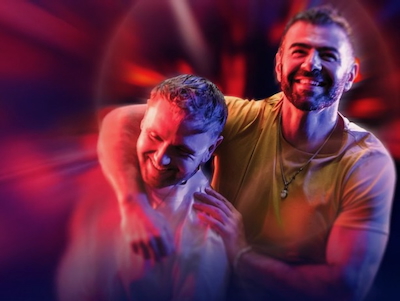
When gay films first showed up on the radar, there were so many themes not yet covered. Themes like coming out, doing tricks, AIDs, bath houses, social unacceptance, and first gay love were explored for the first time. The new theme has run out with new ideas on the gay scene coming up scarce, so filmmakers have to come up with new nuances and ideas. DEPARTURES show frequent gay meetings of a gay Brit couple in Amsterdam with largely beefy gay men instead of clubby slim good-looking twinks.
DEPARTURES is a British LGBTQ+ drama film centring on emotionally damaged men trying to navigate love, sex, self-worth, and identity in contemporary gay culture. The characters are intentionally messy, vulnerable, and psychologically layered rather than idealised romantic figures.
The two main characters are Benji (Lloyd Eyre-Morgan) and Jake (DzvinTag).
Benji is the emotional core of the film. He is a gay man in his thirties from Manchester who desperately wants intimacy and emotional connection but repeatedly sabotages himself through insecurity, dependency, and self-destructive behaviour. He is witty, self-aware, emotionally needy, and often painfully funny in the way he narrates his own suffering. The film presents much of the story through his memories and inner monologue, making him both sympathetic and unreliable. He is shown to be emotionally raw and vulnerable.
Physically, Benji is not portrayed as the stereotypical “perfect” gay leading man. His anxieties about body image and desirability become major themes in the film. He often uses humour, partying, sex, and drugs to mask loneliness and rejection. The story explores his fear of abandonment, low self-esteem, addiction tendencies, and his longing for genuine love. Benji’s emotional spiral after his breakup drives much of the narrative. The film begins with his breakup
Jake is the charismatic but emotionally unavailable man with whom Benji becomes obsessed. He is physically attractive, masculine, sexually confident, and difficult to fully understand. The relationship begins after they meet at an airport and start taking secret monthly trips to Amsterdam together. Jake initially appears exciting and liberating to Benji, but gradually becomes emotionally distant and manipulative. Jake embodies several themes the film critiques:
toxic masculinity, fear of vulnerability, compartmentalized sexuality, and emotionally transactional relationships. He is shown to be living a “double life,” suggesting internalized shame and unresolved identity conflicts. He is neither villain nor hero. The film presents him as another damaged person who cannot give Benji the emotional safety he needs.
Other characters include Rya, Robbie, Kieran and Venessa, with the most interesting one being his Aunt Janet (Lorraine Stanley), who brings her client to Benji’s home, not to mention her stealing and selling Benji’s dog Banjo and selling it for 40 quid. She loves Benji deeply but has difficulty expressing emotional understanding in modern language. She also carries trauma from domestic abuse and guilt connected to Benji’s childhood. Janet represents generational tension: older attitudes toward homosexuality, working-class survival mentality, and imperfect but genuine maternal love. Stanley steals every scene she appears in, her character being the most outlandish.
DEPARTURES comes off as taking a lighter look at what is quite a serious topic, a toxic relationship that can turn abusive at one point and loving the next. The addition of animation to the scenes, such as hearts emanating from the characters, also lightens the heavy topic.
The film, which has received, at the time of writing, 95% approval on Rotten Tomatoes, succeeds in its emotional honesty, subtle and dark humour and raw depiction of toxic gay relationships. The strong performances by Lloyd Eyre-Morgan and David Tag help as well.
DEPARTURES from Filmwelike opens in theatres May 22nd and is worth a look.
Trailer:
THE FURIOUS (HK/China 2025) ***
Directed by Kenji Tanigaki
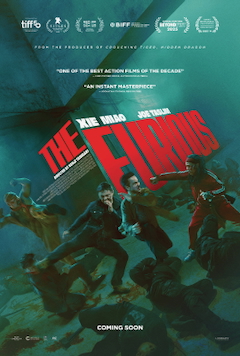
Action movies make a lot of money. Examples being the John Wick franchise, the Bourne Identity franchise, the EQUALIZER series, just to mention a few. The key to all these is the choreographed action scenes and maybe a little plot. THE FURIOUS satisfies the plot criterion with a deaf-mute kung-fu expert father who trains his daughter before she is kidnapped in a human trafficking scheme involving top brass. The plot is only secondary to the film, but at least the film plays the plot as if it is all important, which is a good plan. The action sequences are excellent and better than the average Hollywood action flick. The introduction of an archer bad guy and a strong man bad guy helps, too. Just sit back and enjoy the violence! Opens across Canada May 29th.
Trailer:
PRESSURE (UK/France 2026) ***½
Directed by Anthony Maras

The film centres on Group Captain James Martin Stag (Andrew Scott). Stagg was a Scottish Met Office meteorologist attached to the Royal Air Force during the Second World War who notably persuaded General Dwight D. Eisenhower to postpone the date of the Allied invasion of Europe from 5 June 1944.
The time setting of the drama is the tense 72 hours before D-Day, and with the fate of the free world hanging in the balance, Pressure follows General Dwight D. Eisenhower (Brendan Fraser) and Captain James Stagg as they face an impossible choice: launch the largest and most dangerous seaborne invasion in history or risk losing the war altogether. Though the film is based on the stage play by Andrew Haig, the film does not feel like one, as it includes footage of th Allied Normandy invasion at the end of the film. The invasion was the beginning of Spielberg’s SAVING PRIVATE RYAN. The movie focuses less on battlefield combat and more on the agonising decision-making that determined whether the invasion would proceed at all.
The story begins in southern England in early June 1944. Allied forces are assembled for Operation Overlord, the massive invasion of Nazi-occupied France. Supreme Commander Dwight D. Eisenhower faces enormous pressure from military commanders demanding that the attack begin immediately. Every extra day risks leaks, German discovery, worsening troop morale, and logistical disaster. At the centre of the drama is Scottish meteorologist James Stagg. Stagg is tasked with interpreting chaotic and conflicting weather data from Allied forecasters. The English Channel is being battered by storms, high winds, and dangerous surf conditions. If the invasion fleet sails under bad weather, thousands of soldiers could drown before even reaching Normandy.
The film reportedly dramatised the fierce disagreements among meteorological experts. One American forecaster, Irving Krick (Chris Messina, I CARE FOR YOU), believes conditions will improve enough for an invasion. Others argue that the weather is catastrophic and unpredictable. Stagg, quiet but stubborn, increasingly clashes with military officials who want certainty where none exists. As the hours tick down, Eisenhower must choose between delaying the invasion indefinitely, launching into near-suicidal weather, or trusting Stagg’s narrow prediction of a brief break in the storm.
The decision is left at the climax of the film, though the world (audience included) knows that the invasion eventually took place, its painful success leading to the victory against Germany of WWII.
Historically, that forecast proved correct — the Germans assumed the storm made invasion impossible and were caught off guard.
The pleasures derived from the film are the dramatic performances of the actors, particularly of Andrew Scott delivering a controlled yet nuanced troubled decision, as well as Fraser playing General Eisenhower and also Chris Messina as the charismatic and over-confident other meteorologist who predicted contrary weather.
The talk-heavy and stage play original can be felt, and though this might put off action fans, PRESSURE is not an action film but a suspense drama that works wonders in the way it is delivered, thanks to all departments concerned, especially the performances.
PRESSURE opens in theatres May 29th
Trailer:
ROOM TO MOVE (USA 2025) ***
Directed by Alexander Hammer
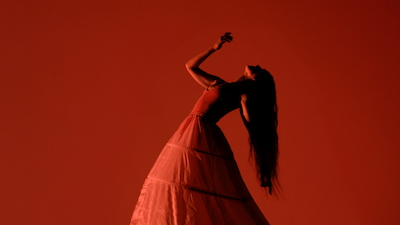
Autism is an affliction that has only recently been studied since the 1990s, when awareness of autism became widely known. Autism, also known as autism spectrum disorder (ASD), is a condition characterized by impairment in social communication and interaction, as well as a need or strong preference for predictability and routine, sensory processing differences, focused interests, or repetitive behaviours. Features of autism are present from early childhood, and the condition typically persists throughout life. Because autism is a spectrum disorder, presentations vary, and support needs range from minimal to the person being non-speaking or needing 24-hour care. In the Netflix doc ROOM TO MOVE, one such case, that of dancer Jenn Freeman, is closely examined.
Dancer Jenn Freeman channels her recent autism diagnosis into creating her first full-length dance piece, exploring identity through movement.
A major emotional thread of the doc involves Jenn trying to understand her identity after finally receiving a diagnosis at age 33. The diagnosis is both liberating and painful as it explains years of confusion and social struggle,\while she realizes how long she lived without understanding herself.
On the side, the film also subtly turns inward toward director Alexander Hammer himself. As he documents Jenn’s experience, he begins reflecting on his own perceptions and identity, making the documentary partly about empathy and self-recognition.
Despite a bit of receptiveness, director Hammer’s doc should be praised for its raw honesty about both his subject (especially in showing audiences how she endures pain and discomfort) and Jenn’s conflicted journey through life.
ROOM TO MOVE premiered at the 2025 Tribeca Festival before arriving on Netflix on May 27, 2026.
Trailer: