
As artificial intelligence accelerates across Canadian institutions, questions of bias and accountability are becoming impossible to ignore. A new episode of the Canadian Bar Association’s Verdicts & Voices podcast brings Black legal scholars to the forefront of that debate.
Artificial intelligence increasingly shapes how decisions are made in policing, immigration, employment, and access to services. Yet the systems driving those decisions often reflect the same inequities embedded in society. On Wednesday, November 5, the Canadian Bar Association releases a timely new episode of its in-house podcast, Verdicts & Voices, placing those concerns squarely within a legal and policy framework.
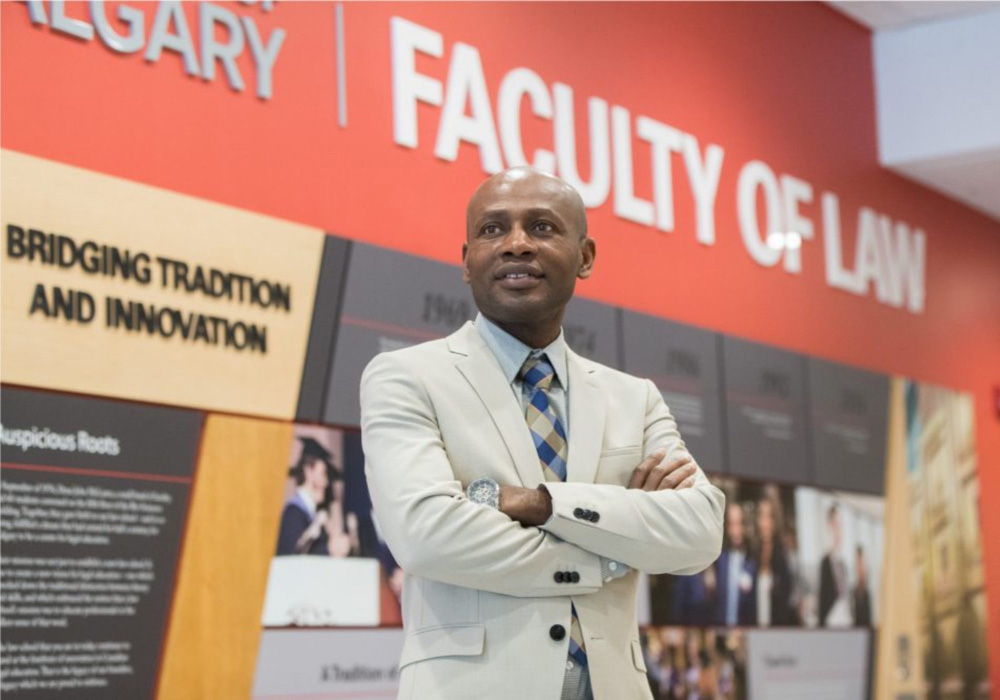
The episode features two Black law professors whose work sits at the intersection of technology, law, and racial justice: Gideon Christian, a professor of AI and Law and the University Excellence Research Chair in AI and Law at the Faculty of Law, University of Calgary, and Jake Effoduh of Toronto Metropolitan University. Together, they examine how racial bias is reproduced in AI systems and why the absence of Black expertise on Canada’s new federal AI Task Force raises serious questions about legitimacy, trust, and effectiveness.
When technology mirrors existing inequities
At the heart of the conversation is a clear reality: AI systems are trained on data, and data reflects human choices, priorities, and blind spots. When historical datasets are shaped by discrimination or exclusion, the outputs of AI risk amplifying those same patterns. Christian and Effoduh discuss how this dynamic plays out in areas such as algorithmic surveillance, automated decision-making, and predictive tools that disproportionately affect Black communities.
Their analysis reframes AI bias as a legal and governance issue rather than a purely technical flaw. Without strong oversight, inclusive design, and accountability mechanisms, AI can quietly entrench inequity under the appearance of neutrality.
Representation and the federal AI Task Force
The episode also turns a critical lens on the federal government’s newly formed AI Task Force. While the body is intended to guide Canada’s approach to artificial intelligence, its lack of Black experts has drawn concern. For Christian and Effoduh, this absence is not symbolic. It directly affects the kinds of risks identified, the communities considered, and the policy solutions proposed.
They argue that meaningful representation improves outcomes by broadening perspectives at the decision-making table. Diverse expertise helps anticipate real-world impacts, particularly for communities that have historically borne the brunt of technological experimentation without adequate safeguards.
Why Black legal voices matter in AI governance
The discussion underscores the role Black legal scholars play in shaping a more responsible AI future. Their lived experience, combined with legal and technical expertise, positions them to identify harms that might otherwise be overlooked. In the podcast, both professors emphasize that inclusion is not about optics. It is about building systems that serve the public fairly and lawfully.
Listeners are invited to consider who defines progress in emerging technologies and whose knowledge is treated as essential. In a country that prides itself on equity and multiculturalism, those questions carry particular weight.
A conversation that extends beyond the law
This episode of Verdicts & Voices lands at a moment when AI governance is rapidly evolving. Canada’s legal community, policymakers, and the public are grappling with how to balance innovation with the protection of rights. By centring Black expertise, the podcast expands the conversation beyond efficiency and competitiveness, toward justice, accountability, and trust.
As artificial intelligence becomes embedded in everyday life, the insights shared by Gideon Christian and Jake Effoduh serve as a reminder that technology does not exist in isolation. It reflects the values of those who design, regulate, and deploy it.
Their message is clear. An inclusive approach to AI policy is not optional. It is foundational to building systems that uphold fairness, protect communities, and earn public confidence in the years ahead.