
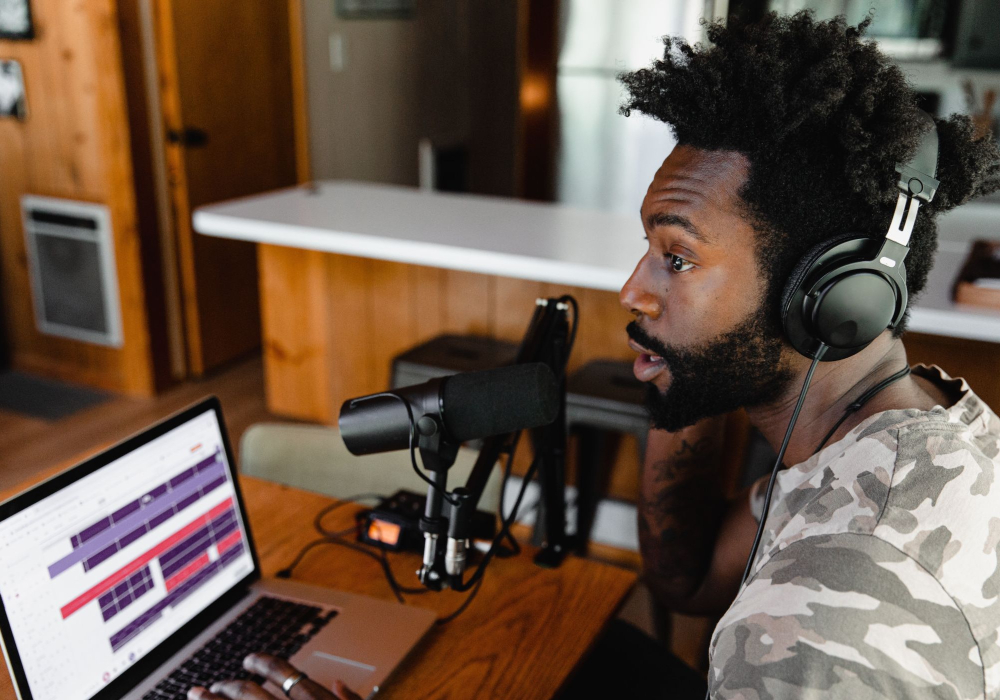
Spoken word pioneer and beatboxer Eddy (DaOriginalOne) David joins Afropolitan Dialogues to unpack a chilling discovery, his own archived history quietly vanishing from Wikipedia and old festival pages. We trace the Royal Ontario Museum protests, the gentrification of Little Jamaica, the disappearance of Africville, and the fragility of community radio archives, then explore critical thinking and oral tradition as tools for guarding Black Canadian memory.
A few weeks before we recorded this episode, Eddy David, known to many as DaOriginalOne, went looking for his own history online and found that pieces of it had simply disappeared. Wikipedia entries gone. Festival credits gone. Pages he had personally seen years earlier, quietly deleted. I have known Eddy for decades, since before either of us had a website or a podcast, back when I was the one following him around with a camera, documenting his earliest shows.
So when he posted about what he had found, I knew we needed to talk about it properly. That conversation became this episode of Afropolitan Dialogues, and it grew into something much bigger than a missing Wikipedia page, a wide-ranging look at how our history gets erased, rewritten and reclaimed in Canada.
This conversation moves from the Royal Ontario Museum protests from the late '80s/early '90s over the Into the Heart of Africa exhibit, to the slow disappearance of Little Jamaica along Eglinton West, to the loss of communities like Africville and Seneca Village. We talk about who controls the narrative when governments change, when funding gets cut, and when a server somewhere simply goes dark.
I also wanted to get into what artists and cultural workers owe the next generation. Eddy argues that critical thinking, not just documentation, is the real safeguard against erasure, and that oral tradition still has a place even in a digital world that can lose decades of work to a dead file format or a defunded radio station. We also dig into AI, not as a threat to creativity, but as a tool that can only ever reorganize what we have already built, leaving the real creative work to us.
Conversation highlights
- We learn how a routine portfolio refresh led Eddy to discover that his own Wikipedia page, along with years of Harbourfront Centre credits and partnership history, had vanished from the internet.
- Eddy and I revisit the Royal Ontario Museum's 1989 Into the Heart of Africa exhibit, the protests it sparked, and the arrests that became known as the ROM 11.
- Eddy traces his roots to Young Poets Ottawa and the Northern Griots Network, and the original mission of countering negative media portrayals of our community through documentation and performance.
- We discuss how political shifts, from the Obama era to renewed attacks on critical race theory in the United States, repeatedly threaten institutional progress that communities fought hard to win.
- Eddy shares how Nelson Mandela was once branded a terrorist in his own school years, only to have the same institutions later celebrate him as a hero, and what that taught him about who controls a narrative.
- We talk through the disappearance of communities, including Africville in Halifax and Seneca Village in New York, both erased to make way for parkland.
- I ask Eddy about the renaming of Eglinton West Station to Cedarvale and what that means for the historical identity of Little Jamaica, alongside the demolition of Honest Ed's and what was lost when its photo-covered walls came down.
- Eddy recalls working as an AV technician the day part of Regent Park was demolished, and reflects on watching a community celebrate the loss of its own buildings on camera.
- We stress the role of campus and community radio, citing CHUO and CKCU in Ottawa as among the few surviving archives of our music and culture from the past three decades.
- Eddy unpacks the myth of the first Black person to do something, and how being first to register in someone else's timeline is not the same as being the actual originator.
- Our discussion turns to AI, with Eddy describing it as a tool that can only restructure the past, leaving human creativity responsible for building anything genuinely new.
- Eddy tells me about eCreativ, his consulting practice helping artists and event organizers build sustainable, professional businesses around their creative work.
Topics covered
- Digital erasure of Black Canadian artists and cultural history
- The 1989 Royal Ontario Museum protests and the ROM 11
- Young Poets Ottawa and the Northern Griots Network
- Media bias and the reframing of Black leaders over time
- The disappearance of Africville and Seneca Village
- Gentrification of Little Jamaica and the renaming of Eglinton West Station to Cedarvale
- The demolition of Honest Ed's and the loss of its community photo archive
- Regent Park redevelopment and displacement
- Community and campus radio as cultural archives
- Critical thinking as a tool against historical revisionism
- Oral tradition and intergenerational storytelling
- The fragility of digital formats and file obsolescence
- Artificial intelligence as a creative tool rather than a replacement
- Building sustainable, professional businesses as a creative artist
- Legacy, mentorship and generational wealth
Notable quotes
On erasure and memory
"It's been interesting to see it for myself, see my own history deleted." (00:56:48, Eddy David)
"This is like we're doing right now never happened." (00:28:51, Eddy David)
"We have whole towns that are gone, Black communities within Canada that are gone." (00:22:56, Eddy David)
On identity and representation
"They keep on calling us a minority, but we actually are a global majority." (00:51:07, Eddy David)
"Nelson Mandela used to be a terrorist." (00:19:09, Eddy David)
On technology and AI
"AI is only as good as what we've programmed into it. It is not going to create anything new." (01:18:54, Eddy David)
"Memory is privilege." (01:14:39, Meres J. Weche)
On legacy and the next generation
"Every exit is a door opening to somewhere else." (00:56:39, Eddy David)
"Critical thinking is one of the main things that we have to teach our youth." (00:44:08, Eddy David)
About the guest
Eddy David, known to many as DaOriginalOne, is a spoken word artist, beatboxer, MC and community organizer who helped lay the foundation for hip hop culture in Ottawa. He founded Young Poets Ottawa, a branch of Mother Africa's Children First movement and went on to co-found the Northern Griots Network, a national collective supporting African Canadian spoken word artists across cities including Halifax, Montreal, Ottawa, Toronto, Calgary and Vancouver.
Over more than two decades, Eddy has produced national storytelling conferences in partnership with Harbourfront Centre, mentored beatboxers who went on to become world champions, and worked on community arts access programs in underserved Toronto neighbourhoods. He now runs eCreativ Consulting, where he helps artists, creatives and event organizers build professional, sustainable businesses around their work. I have known Eddy since the earliest days of his career, when I was the one documenting his shows with a camera, and watching that journey unfold over thirty years is part of what made this conversation so personal for me.
About eCreativ Consulting
eCreativ Consulting, also referred to in Eddy's promotional material as eCreativ Arts and Event Management, is his consulting practice for artists and creative professionals. The company helps clients plan and manage events from start to finish, set up business systems, including payments, contracts, and bookings, build brand tools such as electronic press kits and promotional materials, manage event technology, such as sound, lighting, and livestreaming, and handle administrative support, such as scheduling and payments. The goal, as Eddy told me, is to help creative service providers get paid properly and run their work like a real business rather than a side hustle squeezed in after a day job.
Where to find the guest on social media
- Instagram, @eddy_daoriginalone
- LinkedIn, Eddy David
The business email for eCreativ Consulting inquiries is
Useful resources
- Afropolitan Dialogues on AfroToronto.com
- CBC News, ROM apologizes for 1989 Into the Heart of Africa exhibit
- TTC, Eglinton West Station officially renamed Cedarvale
- City of Toronto, Sankofa Square background
- Wikipedia, Little Jamaica
Keeping the record straight
When Eddy posted about his disappearing archives, I did not see a one-off complaint. I saw a warning shot for every artist, cultural worker and community organization that assumes the internet remembers things on its own. It does not. Servers get decommissioned, websites get redesigned, funding gets cut, and the people who built the first version of the record move on or pass away. What survives is whatever someone deliberately chose to save.
That is the thread running underneath every example we discussed, from the Royal Ontario Museum's reckoning with Into the Heart of Africa, to Honest Ed's walls coming down with decades of our performance history still hanging on them, to a single hard drive somewhere holding music that can no longer be opened.
The fix Eddy proposes is not complicated, even if it is demanding: Keep your own receipts, get interviewed, sit at the feet of your elders, and treat archiving as part of the work rather than an afterthought. For a community that has already had its history rewritten more than once, that discipline is not optional, and it is exactly why I wanted to put this conversation on the record.