
FILM REVIEWS:
ALL THAT'S LEFT OF YOU (Germany/Cyprus/Palestine/Jordan/Greece/Qatar/Saudi Arabia 2025) ****
Directed by Cherien Dabis
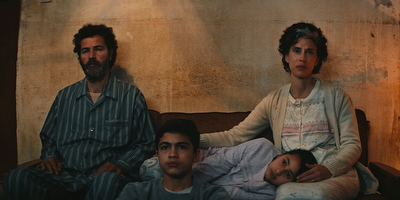
ALL THAT’S LEFT OF YOU and the recent German film THE SOUND OF FALLING share the identical theme of generations of a family, a time frame of almost a century. Both films suffer the same setbacks of being overlooked, the former lasting over 3 hours and the latter almost 3 hours. Another problem is the length of both films, that deter audiences from viewing the film. A major problem is that each film has to clearly identify each character and make each character radically distinguishable from the others. This is particularly bad in THE SOUND OF FALLING. The film gets confusing, and if one is lost at the halfway mark, sitting through the remaining three hours is useless. The use of intercut nonlinear chronological storytelling tends to confuse the storyline and also break the flow. of the narrative. Imagine stories like Charles Dickens’s OLIVER TWIST or GREAT EXPECTATIONS told in non-chronological order. The result will be disastrous
FOR ALL THAT’S LEFT OF YOU, thankfully, has a stronger narrative to propel the story along. After a Palestinian teen gets swept up into a West Bank protest, his mother recounts the family story of hope (in flashback), courage and relentless struggle that led to this fateful moment.
The film is first set in 1988 West Bank, and then in 1948, Jaffa, Palestine.
In order to appreciate the story in the film, a bit of knowledge is required of both the West Band and Jaffa.
Tel Aviv, officially Tel Aviv-Yafo, and also known as Tel Aviv-Jaffa, is the most populous city in the Gush Dan metropolitan area of Israel. Located on the Israeli Mediterranean coastline and with a population of 495,230, it is the economic and technological centre of the country and a global high-tech hub. The city, annexed to Jordan, surrendered to the Haganah on 14 May 1948 and shortly after, the British police and army left the city. Israeli historian Benny Morris writes that "There was widespread institutional and private looting by Haganah and IZL troops and Tel Aviv citizens who infiltrated the town, there was robbery on the roads by patrolling Jewish troops. The 3,800 Arabs who remained in Jaffa after the exodus were concentrated in the Ajami district and subject to strict martial law. The military administration in Jaffa lasted until 1 June 1949, at which point, the Tel Aviv Municipality took over the administration. The grandfather in the film has his story told in 1948 when the mayhem occurred.
The story travels to 1948 Jaffa and the Nakba, where Noor’s grandfather, Sharif, resists fleeing as Israeli forces expel Palestinians from their homes. His son Salim grows up under occupation, navigating the trauma of exile and the weight of a father's choices. The film portrays the personal costs of colonial violence while honouring Palestinian resilience and steadfast humanity.
Noor and his family are constantly harassed by the Israeli soldiers. One of the key scenes shows Noor’s father humiliated in front of him, an incident that Noor cannot accept, thus calling his father a coward. Looking at the father’s side, the father had no choice.
The film takes a personal approach to the story rather than a political one. But the effects are just as effective, with the film working best this way. A historical epic, the powerful film chronicles the story of the land through the eyes of one family and three generations of struggle. It is an emotional family portrait, examining the relationship between grandfather, father and son, and the legacy of trauma passed down to each. It is a drama with piercing moments of joy, love and humour that keep it from becoming too hard to watch.
ALL THAT’S LEFT OF YOU opens at the TIFF Lightboxon January 30th.
Trailer:
BACK TO THE PAST (Hong Kong 2025) *** ½
Directed by Ng Yuen-fai and Jack Lai
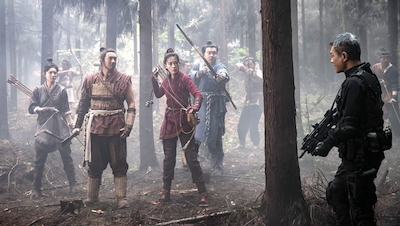
BACK TO THE PAST is a fun-filled romp that should satisfy fans of period Chinese action flicks. The film is based on the novel The Chronicles of Searching Qin
by Huang Yiand and the 2001 TV series A STEP INTO THE PAST. A Step into the Past is a 2001 Hong Kong television series produced by TVB and based on Huang Yi's novel of the same Chinese title. The series tells the story of a 21st-century Hong Kong VIPPU Inspector who travels back in time to the Warring States period of ancient China. He is involved in a number of important historical events that led to the first unification of China under the Qin dynasty.
Hong Siu-lung (Louis Koo), who also produced the film) is a 21st-century VIPPU Inspector in Hong Kong. In the first episode, Hong and his colleagues stand guard and rescue an attack on an exhibition of the First Emperor's Terracotta Army. Impressed with Hong's rescue attempt, Lee Siu-chiu and Doctor Wu Yau recruit him for a secret time-travelling experiment. Hong agrees to help them in exchange for an opportunity to travel back in time to salvage his failed relationship with his girlfriend. He is tasked to travel back more than two thousand years to the Qin dynasty, half an hour prior to the coronation of Ying Ching in 247 BC, and document the event with a digital camera before a swift departure. However, a critical error occurs during the traveling stage, and Hong is sent further back in time three years earlier than originally planned. This is the basis of the stor,y and in the film, there is a lot of condensation of the story, moving the plot at a breakneck pace.
The story takes place nineteen years after the conclusion of the television series. Hong Siu-lung has retired to the countryside with his wife and children, living a peaceful life. However, at the height of Ying Ching's power, after unifying the six states and dominating the realm, he is suddenly attacked by Ken (Michael Miu), a modern man who leads a group traveling through time. Wrongfully imprisoned in his early years, Ken vows to rewrite history. He attempts to usurp the throne and proclaim himself emperor in order to make up for the regrets of his life.
For the almost 2-hour running time that includes an alternative ending, compared to the series, the film is a condensed narrative that would be more appreciated by someone who has some familiarity with the TV story. The focus of the film is the continuation/sequel, not a full retelling. A solid take on the time travel fantasy, the story also considers the consequences of time travel, including the importance of not changing historical events that occur at a cost of interfering with history.
The film is coldly Louis Ko’s baby. Produced by Koo's One Cool Film Production, filming for Back to the Past began in April 2019 in Guizhou and wrapped up on 7 July 2019. The film finally gets a theatrical release that includes Toronto’s downtown libation and Yonge and Dundas on January 30th.
Trailer:
PIKE RIVER (NEW ZEALAND 2025) ***
Directed by Richard Sarkies
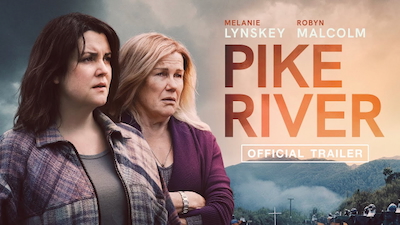
PIKE RIVER, the film opens in the setting of 2010, the West Coast of the South Island, New Zealand. It is the setting, too, of the Pike River Mine Disaster.
The Pike River Mine incident ranks as New Zealand's worst mining disaster since 1914, when 43 men died at Ralph's Mine in Huntly.
The Pike River Mine disaster was a coal mining accident that began on 19 November 2010 in the Pike River Mine, 46 km (29 mi) northeast of Greymouth, in the West Coast region of New Zealand's South Island, following a methane explosion at approximately 3:44 pm. The accident resulted in the deaths of 29 miners. At the time of the initial explosion on 19 November, 31 miners and contractors were below ground. 16 miners and 13 contractors were believed to be located at least 1.5 km (1,600 yd) from the mine's entrance, while two miners managed to walk from the mine and were treated for moderate injuries. Subsequent explosions on 24, 26, and 28 November ended any hopes of any further survivors and raised serious doubt that any bodies would ever be recovered.
In the film PIKE RIVER, Melanie Lynskey stars in this David and Goliath drama based on actual events following the 2010 Pike River Mine disaster that took the lives of nearly 30 men working underground. A touchpoint in global culture at the time, two women—one who lost her son, the other her husband—would make it their mission to bring a negligent corporation to account, no matter the odds stacked against them. Rockhouse and Milton are the last names of the characters, and the two names are on the list of dead miners of the disaster. So, the names have not been changed.
The film can be divided into three parts. The first introduces the two main characters, the two women Rockhouse and Osborne, who are at loggerheads at first but soon bond in their fight against injustice. The second part shows the personal grief each one goes through and the effects of the disaster, and the third, the fight against the injustice of both the company and the government.
There have been complaints that families were not consulted during the making of the film. The disaster itself — multiple explosions in 2010 that resulted in 29 deaths — and the families’ long fight for answers are factual foundations of the story. The central figures, Anna Osborne and Sonya Rockhouse, did engage publicly and persistently in seeking accountability after losing loved ones. But it should be noted that despite political shifts and years of campaigning, justice and full recovery of the miners’ bodies and the mine’s evidence have remained unresolved issues as of the mid-2020s. The audience is led to believe that all went well in the end, but the film ends with hope, but things turned south afterwards, facts that were omitted in the film.
In Canada, PIKE RIVER opens on digital January 30th.
Trailer:
SHELTER (UK/USA 2026) ***½
Directed by Ric Roman Waugh
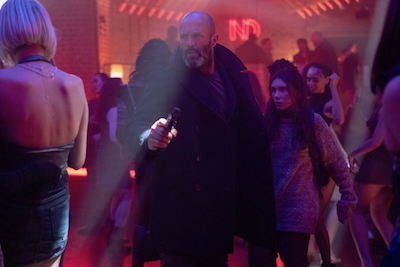
On a remote coastal island, a man (Jason Statham) living in self-imposed exile rescues a young girl from a deadly storm. Her uncle dies in the storm while locked in the boat. This action sets off a chain of events, bringing him out of seclusion and both into harm’s way. As their lives intertwine, he must protect the orphaned girl while battling enemies from his past, setting them both on a breathless odyssey of survival and a deeper journey toward redemption.
It turns out the man is Mason, a highly trained, former top operative (no surprise here) who gives him super fighting powers. He is hiding from his past, and particularly, the villain of the piece, played by Bill Nighy, who will not leave him alone.
Besides Statham and Nighy, it is also good to see character British actor Daniel Mays playing a past colleague of Mason’s.
What distinguishes this Statham movie from the others is the locations, both exterior and interior.
One of the action settings takes place at a famous London nightclub called Fabric, but is called Neon Oracle instead. I have been to Fabric in London at Farringdon Tube a dozen times in London. Fabric is called that on the weekdays, but on Sundays it is mostly gay, and the venue is renamed DTPM.
As for exteriors, the setting of Mason’s character is a secluded island in the Scottish Isles of the Outer Hebrides. Despite the Outer Hebrides setting, the film chose to shoot in County Wicklow, Ireland, with the old lighthouse off the island built from scratch, where Mason occupies. The setting is actually Travelahawk, a secluded pebble beach in Wicklow Town. The landscape is simply stunning. The action in the film does not take place all the time, allowing the audience to enjoy the locations of the film, which actually make most of the film’s pleasures.
The sets are also phenomenal. The entire boathouse and lighthouse can be seen and felt when Mason runs from his living quarters or pushes his dory boat out into the water.
Besides the focus on action in the action film, personal emotions are also added to the entertainment equation. The script also includes the story of two lost souls who are both outcasts of society who meet one another and help each other deal with their own demons and hardships, and find an important connection of bonding.
The film also contains all the modern technologies like surveillance, allowing Mason to be detected wherever he goes.
SHELTER does not have the most action of all the Statham films, say THE BEEKEEPER, but it includes many other elements like setting, character emotions, and sets that complement the action set pieces, a big plus in an action film, distinguishing SHELTER as one of the better action films of the year.
Trailer: