
FILM REVIEWS:
CACTUS PEARS (original Marathi title: Sabar Bonda) (India/Canada/UK 2025) ***
Directed by Rohan Parashuram Kanawade
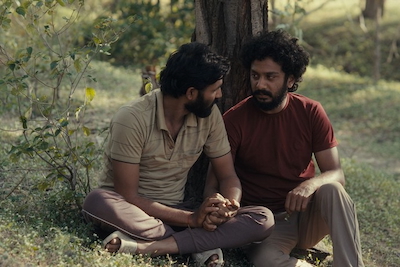
CACTUS PEARS is a 2025 Indian drama/romance film that tells a tender, character-driven story about love, identity, and cultural expectations. The film is directed and written by Rohan Parashuram Kanawade and stars Bhushaan Manoj (Anand), Suraaj Suman (Balya), and Jayshri Jagtap.
There are not many gay films from India, a place where homosexuality is often met with disgust and violence. This gay film, from India, offers the world a look at how being gay is treated in rural India.
Urban areas (Delhi, Mumbai, Bengaluru, Chennai) tend to be more accepting, with Pride events, LGBTQ+ organizations, and media visibility. Rural and conservative regions often remain hostile. In the film where Amand gets back to his village for his father’s funeral, there is talk of his non-marriage status. He is told to tell the villagers that the girl cheated on him and married someone else. It can be seen the same problems many LGBTQ+ people face: family pressure to marry heterosexually. The occasional harassment or violence is absent, but can be noticed to be inherent in the atmosphere. Same-sex marriage is still not legal in India.
The protagonist is Anand, a 30-something call-centre worker from Mumbai. After the death of his father, he returns to his ancestral village for a 10-day mourning period with his mother. Once there, as tradition dictates, lengthy funeral rites are being prepared. Going back is not easy for a man who fled rural life for the city in order to live his homosexuality more freely. It doesn't take long, despite the tragic circumstances, for everyone to start asking intrusive questions and wondering whether Anand is thinking about marrying a woman soon... Fortunately, he can count on his mother's kindness, as she loves him just as he is. Anand reconnects with his childhood friend Balya, a local farmer who is also navigating his own pressures around marriage and expectations. Over the course of the mourning period, the two men spend time together, rediscover their bond, and grow closer emotionally and physically.
The story’s time span is the 10 days that Anand sends for his father's death ritual. When he rekindles an affair with Balya, the tenth day approaches, and Anand has to make his decision. Balya wishes to move to Mumbai with Anand. But Anand’s family says the house is too small, and Anand’s uncle is against it. There, it turns out, that Anand has come out to his father and mother and not to the others who do not know that Anand is gay.
The film is called CACTUS PEARS because the sweet pear with its red flesh resembles the forbidden fruit of Adam and Eve in the Garden of Eden. Balya gives Amand a cactus pear, and he peels away the flesh and eats the fruit, enjoying its sweetness, thus entering into the temptation of the flesh.
The film, unlike many other queer films from the west, though a very slow burn, but is to be praised for its sensitive portrayal of queer life in a society with traditional expectations. There is no sex scene but a mild frottage scene between the two men.
The film won the Grand Jury Prize (World Cinema – Dramatic) at the 2025 Sundance Film Festival, marking a historic moment as the first Marathi-language film to compete there. The film opens in theatreson January 2nd, 2026.
Trailer:
DJ AHMET (North Macedonia, Czech Republic/Serbia, Croatia 2025) ***
Directed by Georgi M. Unkovski

DJ AHMET (North Macedonia, Czech Republic/Serbia, Croatia 2025) ***
Directed by Georgi M. Unkovski
Ahmet, a 15-year-old boy from a remote Yuruk village in North Macedonia, finds refuge in music while navigating his father’s expectations, a conservative community, and his first experience with love — a girl already promised to someone else.
In the classic Taviani Brothers 1977 film PADRE, PADRONE, there is the unforgettable scene in which the father removes his son Gavino from the classroom to force him to work as a shepherd. The act is driven by the father’s authoritarian control and belief that education is useless for their rural, traditional life in Sardinia.
In the film DJ AHMET, the protagonist faces the same dilemma; even though the father does not physically remove his son from the classroom, there is a message to Ahmet that his father is there to fetch him. His father later tells him that he has spoken to the headmaster to stop his schooling,
In the same way as in PADRE PADRONE, where the father needs Gavino’s labour and wants to assert dominance, cutting him off from schooling so he will grow up obedient and bound to the land. Ahmet is also to tend sheep as well as to look after his younger brother, who is unable to speak. This moment is crucial in the film because it marks the beginning of Ahmet’s isolation, illiteracy, and psychological oppression, which the story later contrasts with his struggle for independence in the area of music.
All things considered, the film is a coming-of-age drama that centres on Ahmet, a 15-year-old boy living in a remote Yörük/Turkic village in rural North Macedonia. Caught between his family duties, conservative community expectations, and personal dreams, Ahmet finds refuge and identity in music, particularly electronic beats, which offer him an escape from the strict, tradition-bound world he’s grown up in. At its core, the story explores youthful rebellion, cultural tradition vs modernity, and first love. Ahmet dreams of being a DJ while tending sheep and helping his family, and his passion for music deepens when he falls for Aya, a girl who shares his love of rhythm but is already promised to someone else. Their connection and Ahmet’s pursuit of music become a symbol of self-expression and liberation amidst societal pressures
The comedy in the film is sincere and honest in form, as seen when Ahemt tastes his girl’s baklava for the first time, and they both giggle; she tells him that he does not know how to lie.
In DJ AHMET, director Unkovski explores the delicate balance between tradition and self-expression, particularly within a small, close-knit community. The tension that ariseswhen individual desires clash with the expectations of the collective. is captured. There is also a nod to Mike Nichols’ THE GRADUATE in the way Ahmet hicks Aya’s arranged wedding. Though the two films are highly different, the scene of the bus pulling away reminds the film of the ending of THE GRADUATE. But there are twists in the plot regarding the father’s change of heart, which makes a nice conclusion to the film.
Trailer:
THE DUTCHMAN (USA 2025) ***
Directed by Andre Holland
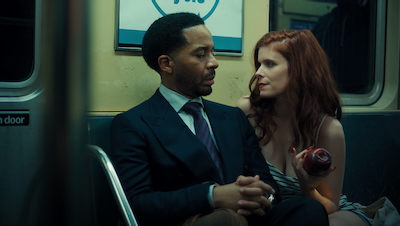
The psychological horror thriller begins with a voiceover claiming the two personas that inhabit a black man, Clay, the subject of the movie.
THE DUTCHMAN is based on the play of the same name, but the film takes the play out into the open on location, so that the staginess is removed. The movie plays like a variation of the film FATAL ATTRACTION. Clay meets a psycho femme fatale who blackmails him into taking her to a fundraising party in which he is delivering a speech. She blackmails him by keeping his sperm in a condom so that she can claim that he had raped her. To make matters worse, Clay’s estranged wife is attending the party.
Clay (André Holland), a successful but troubled black businessman, attends therapy sessions with his wife, Kaya, in an attempt to salvage their marriage. But their mysterious therapist (Stephen McKinley Henderson) is not all that he seems, and begins to unexpectedly appear to Clay outside of their sessions. On a New York subway train, Clay encounters Lula (Kate Mara), a seductive but sinister white stranger who slowly begins to unravel his life. Clay must discover the truth behind this encounter to get back to his wife (Zazie Beetz), heal his fractured soul, and survive the night. In this psychological thriller - a modern adaptation of the 1964 Obie Award-winning play - The Dutchman brings a contemporary edge to the original, exploring themes of race and identity in America.
Director Holland makes his film at a steady and solid pace, keeping the tension always at a high, and makes his film an engrossing one. His Clay is a vulnerable one that the audience can root for, despite his human flaws and failings.
The question is, why is the film called THE DUTCHMAN? The film The Dutchman takes its title from the legend of the Flying Dutchman, a ghost ship condemned to sail endlessly and never make port. In the context of the film, the title is metaphorical rather than literal: The Flying Dutchman myth represents eternal wandering, punishment, and being trapped in a
In the film, the central character, Clay, is similarly adrift—emotionally, morally, and psychologically—unable to escape the consequences of past actions. The title underscores themes of isolation, fate, and inescapability, suggesting a person condemned to move forward without resolution or redemption.
As the film veers towards its conclusion, one looks at the question of whether Clay can work and earn redemption. Clay realizes the error of his ways, and finally admits the error of his ways to his wife, but then has to deal with Lula. The film also steers towards surrealism (there is Sa alvador Dali postern the train) so that one wonders if all his torment is real or in his mind.
Nevertheless. THE DUTCHMAN is a n intriguiging enoigh film, as the play it is based on also is, with a nuanced and excellent performance by director Andre Holland, who plays Cla,y as well as an unforgettable performance by character actor Stephen McKinley Henderson as Dr. Amiri.
THE DUTCHMAN premiered at the 2025 South by Southwest Film & TV Festival in March and is scheduled to open in theatres on January 2, 2026.
Trailer:
THE PLAGUE (USA/Romania 2025) ***½
Directed by Charlie Polinger
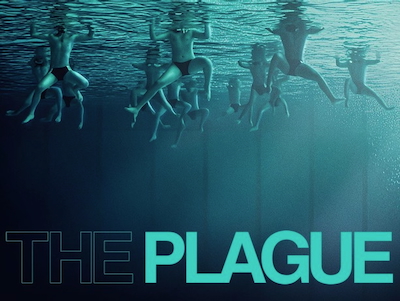
THE PLAGUE made a splash when it premiered at Cannes in 2025, but obviously not enough for TIFF to pick it up. But the film finally gets a release, ironically at the TIFF Lightbox on January 2nd. It is the first feature from the director, championed by star Joel Edgerton. The film can best be described as a horror-thriller genre film with LORD OF THE FLIES overtones. What is immediately noticeable at the film’s start is the sound/music mixing and the fluid camerawork that sets the film out, despite it being a rather slow burn, and with a violent conclusion, not to be revealed in this review.
THE PLAGUE could be considered to be too harsh a title for this film, as the illness is seen as a bad rash on the screen that does not cause death. But for the real definition of a plague, it is a serious infectious disease caused by the bacterium Yersinia pestis, spread by infected fleas from rodents or direct contact, with three forms: bubonic (swollen lymph nodes), pneumonic (lungs), and septicemic (blood), often fatal if untreated but curable with prompt antibiotics, infamous for past pandemics like the Black Death, and still occurring today in parts of Africa, Asia, and the Americas. But the film title should be sufficient to arouse possible audience interest, which, in actuality, is not a bad film at all and a worthy debut from a first-time director.
The film is a psychological drama thriller that focuses on a socially anxious 12-year-old boy who is pulled into a cruel tradition at an all-boys water polo camp. The subject is Ben, played byEverett Blunck, Edgerton, who plays the camp coach who is aware of the bullying that is going on, and can only do so much to contain the impending disaster that occurs from the situation. The audience can only watch and pray,
Ben is initiallyteased by not being able to pronounce certain words. But the main victim is another kid who has developed a severe rash over his body. No other polo team member wants to be close to him for fear of catching it. But the kid is also a bit of an anomaly and a very weird one at that. Ben befriends him with disastrous results.
It is good to note that initially, when Joel Edgerton received the script from Charlie Polinger, he wanted to direct the film. However, Polinger wanted to, with Edgerton instead offering to help get it made. In the press notes, it is said that Polinger set out to "capture a social dread and vulnerability of your body and something you don't see as much with boys because it requires a certain vulnerability to be an object of terror in that way, and cites The Shining, Full Metal Jacket, and Beau Travail as primary sources of inspiration.
THE PLAGUE had its world premiere at the Un Certain Regard section of the 2025 Cannes Film Festival on May 16, 2025, and is scheduled to be given a limited theatrical release in the United States on December 24, 2025, expanding nationwide, including the TIFF Lightbox in Toronto, on January 2, 2026.
Trailer: