
FILM REVIEWS:
THE CHORAL (UK/USA 2025) ****
Directed by Nicholas Hytner

A choral society's male members enlist in World War I, leaving the demanding Dr Guthrie (Academy Award Nominee Ralph Fiennes from CONCLAVE) to recruit teenagers. Together, they experience the joy of singing while the young boys grapple with their impending conscription into the army.
If the film about forming and survival of a choral (choir) during WWI sounds boring or uneventful, this film, THE CHORAL, written by Alan Bennett and directed by Nicholas Hytner (THE MADNESS OF KING GEORGE), serves to prove otherwise. The importance of music is clearly established at the start of the film, through the more elderly population. Music transcends everything, including war. The choral master worked in Germany for several years and therefore faces prejudice against his hiring for the task.
The film is set in a fictional town in Yorkshire. It is all very English, and if one loves a good English film with story and morals included, THE CHORAL is the one to watch. From the beginning scenes, the sight of two lads on their bicycles riding down the winding lanes in the country is simply stunning English beauty.
Director Hytner and writer Bennett capture emotions in key scenes as well as simple ones. At the film’s start, a postman delivers telegrams to soldiers who have died in action. As he delivers one to a mother, with the words: “I’m sorry, missus,” the mother holds the postman’s head, giving him a kiss on the forehead with tears rolling down her face. It is a key moment illustrating the power of emotion that radiates from the work of these two artists, which is also observable in other parts of the film.
Every part of a choir is shown in all its glory and importance. When auditioning for the new choral master, the choral master says: Everyone is to audition. "But we are in the committee, and I’m not prepared to argue one," says one. “The scales will do,” replies the choral master. As different auditions are heard, the audience will be mesmerised by the expressions and songs chosen. This is my favourite segment in the film.
German composers such as Bach, Beethoven and Handel being unacceptable, Dr Guthrie proposes to stage a radical new production of Elgar’s The Dream of Gerontius, its theme of death reflecting the current pains of war. He gets permission from Elgar (played with gusto by Simon Russell Beale) himself for this performance, though not until his daringly interpretive new variations are discovered by the angry Elgar.
The film contains a few excellent quotes, such as: Artists are like that. (referring to one knowing another’s talent) They know each other. The film also contains excellent scenes. The best of it is the choral master’s pep talk with Clyde (Jacob Dudman), a young soldier returning from the war prematurely for loss of his right arm. Clyde can sing but does not want to be in the choral. Life has dealt him a consolation prize - his voice, but otherwise, the loss of a limb and heartbrokenness (his girl now feels differently towards him). It is an excellent written scene, full of raw emotion and openness, and delivered with great effect, demonstrating the oneness between theatre and cinema.
THE CHORAL screened at the Toronto International Film Festival and opens on January 9th. Absolute delight!
Trailer:
THE CHRONOLOGY OF WATER (USA 2025 ) ***
Directed by Kristen Stewart

THE CHRONOLOGY OF WATER is a biographical psychological drama film and the feature directorial debut of Kristen Stewart, adapted from Lidia Yuknavitch’s acclaimed 2011 memoir of the same name.
At the addiction meetings, Lidia (Imogene Poots) is told to talk about it and that that will help. “I am not talking,” she tells the group leader. Then, there are the scenes of overdose, when she lies on the floor, and the medics are trying to revive her. Her arm and veins are shown as she is about to perform an injection. Her sweaty face, bad complexion, and all are shown in close-ups. If there is any consolation from these disturbing scenes, they are occasionally accompanied by uplifting music. While her parents claim that she is doing so well, director Stewart flashes back to her vomiting into the toilet bowl. (Is the vomiting due to the drug taking or her pregnancy?)
Her indecisiveness is no help either. She punches her boyfriend because he is not nice and does nothing. She does not know what to do. She talks to herself.
The sexual abuse by her father is shown in horrible ways. The way he fucks her is shown in a lengthy and disturbing segment that one can only wish they could turn away from. The father alternates between a few moments of tenderness and screaming at her at the top of his voice.
Director Stewart’s film is a difficult watch. It is no easy watch to experience the trauma of an abused individual,l whether the abuse comes from within or from the outside. From Stewart’s fragmentation use of editing, for example, the audience sees a scene and the next edit with the same scene but occurring a few seconds before, she creates the effect of how Lidia feels and acts as she is bipolar and high. But there is redemption, which slowly emerges during the second half of the film.
A young woman finds her voice through the written word and her salvation as a swimmer, ultimately becoming a triumphant teacher, mother, and singular modern writer.
The term chronology means the arrangement of events or dates in the order of their occurrence. The film does not evolve in the same way as the meaning of the word, in relation to water. It is, in fact, a raw, nonlinear life story of Lidia Yuknavitch—from her traumatic childhood and escape into competitive swimming, to fractured relationships, addiction, sexuality, the loss of a child, and ultimately finding her voice as a writer. Rather than following a straightforward narrative, the film uses a fluid, memory-like structure to evoke how trauma, loss, and memory intermingle, transforming suffering into art.
The film mirrors the memoir’s style, with memories and experiences overlapping like waves—showing life as fragmented yet connected. Water (especially her life as a swimmer) functions as a powerful motif for escape, transformation, and emotional depth throughout the film.
But director Stewart’s artsy style can be overpowering at times, to the point that one wonders what all the fuss is about. Yet, one has to give Stewart credit for trying,
Kristen Stewart has an active and successful career in show business since an early age. This film marks her impressive directorial debut. THE CHRONOLOGY OF WATER premiered in the Un Certain Regard section of the 2025 Cannes Film Festival on May 16, 2025. The film received positive reviews from critics. It opens in theatres on January 7th, 2026
TRAILER:
FATHER MOTHER SISTER BROTHER (USA 2025) ***
Directed by Jim Jarmusch
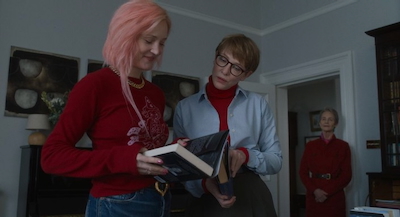
FATHER MOTHER SISTER BROTHER is a 2025 comedy-drama anthology film written and directed by Jim Jarmusch. Starring an ensemble cast that includes Tom Waits, Adam Driver, Mayim Bialik, Charlotte Rampling, Cate Blanchett, Vicky Krieps, Sarah Greene, Indya Moore, and Luka Sabbat, it follows three estranged family relationships in three different countries around the world. The anthology stories are told one after another, not intercut. Intercutting stories often disrupts continuity and destroys whatever has been built up in a segment before switching to the next story. Jarmusch is a filmmaker with a certain style, an odd one like panning a row of residences as a car drives by, for example. Though his films are never the best of the year, they are still an event to look forward to. I will never miss a Jim Jarmusch film. And FATHER MOTHER SISTER BROTHER is one that Jarmusch fans should not miss.
The three stories are all equally interesting, but the last one is the least engaging for one reason: the actors are less proficient than the stars who perform in the first two stories, like John Waits and Adam Driver in the first, and Cate Blanchett. The decision to have the stories set in different cities around the world is an excellent one, giving the film variation and change.
The three stories are called FATHER, the first, MOTHER, the second, and SISTER BROTHER, the final. The best is the second, primarily for the reason that it has Charlotte Rampling as Mother, Cate Blanchett as Timothea, and Vicky Krieps as the other sister. The stores are set in different countries, from the United States to Dublin to Paris, respectively.
Somewhere in a countryside town in the United States, Jeff and Emily drive on a snowy road to a reunion with their estranged and reclusive father. While Emily has no idea how he has enough money to survive without social security following the passing of their mother, Jeff appears to be secretly supporting his father. Further concerned with his loneliness, Jeff brings a box full of expensive groceries. The father appears to hide his real financial state, displaying an old car in the house entrance and messing up the house on purpose, until Emily spots a Rolex, although he pretends it's a fake replica. Seeming not to care about their lives, he forgets about Jeff's recent divorce. After their departure, the father cleans the house and drives in his actual functional car to meet a friend nearby.
Somewhere in Dublin, an elderly, famous writer awaits her annual tea gathering with her two daughters, Timothea and Lilith. The reunion marks the only day in the year they actually see each other, although they all live in Dublin. Timothea's car malfunctions on the way, and in despair, she tries to contact the insurance, but drives to her mother's home to avoid being late. Lilith asks her friend, Jeanette, to pretend she is an Uber driver, avoiding further explanations of her financial state to her mother and sister. During the tea, the mother inquires about their lives, and after some hesitation Timothea announces that she has been promoted to a new position on the city's council for preservation of historic buildings, but is interrupted by Lilith, who announces she also has good news about the new "influencers" of her community, although neither her mother or her sister appears to know what an influencer is. Lilith is spotted with a Rolex, but insists it's a fake replica. In the bathroom, Timothea appears to be overwhelmed by emotion. As the tea ends, Lilith asks her mother to call an uber and the trio waits for the car in silence by the front door.
Somewhere in Paris, Skye and her brother Billy reunite following the passing of their parents in a plane crash in the Azores, and, while driving to their old home, they try to reconnect through memories. At the now-empty apartment, Billy shares with Skye old photos, drawings of their childhood, and an old Rolex of their father's, as well as multiple fake IDs and a fake marriage certificate. The landlord, Madame Gautier, interrupts them, revealing that she personally prevented the insurance company from seizing their parents' belongings, even though they died owing three months of rent. Driving through Paris once again, they head to a warehouse, taking a final look at their parents' old furniture.
FATHER MOTHER SISTER BROTHER had its world premiere in the main competition of the 82nd Venice International Film Festival on August 31, 2025, where it won the Golden Lion. It was theatrically released in the United States by Mubi on December 24. The film opens in Canadian cinemas on January 9, 2026 (English-language release widely across Canada).
Trailer:
HOMEGROWN (USA 2024) ***
Directed by Michael Premo

It is timely with the doc HOMEGROWN being released in North America on the 5th Anniversary of the insurgent attack on the U.S. Capitol— on January 6, 2026
HOMEGROWN brings raw intimacy and unprecedented access to a political moment still unfolding. Shot across battleground communities and key flashpoints of national tension, the documentary reveals the lived experiences of people whose determination to turn their beliefs into action places them on the front lines of America’s political divide.
The film follows three conservative activists—a newly politicized father-to-be in New Jersey, an Air Force veteran organizing conservatives in New York City, and an activist from Texas—crisscrossing the country in the summer of 2020, campaigning for Donald Trump. When they become convinced that the election is stolen, they take their fight to the streets. The result is a chilling portrait of the growing unrest pushing American democracy to the brink.
How bad, ill-informed and moronic are the true Trump supporters? This doc focuses of three such supporters, a doc that would surely shock, if not anger, those who have seen the American democracy crumble and manipulated under President Donald Trump. Michael Premo, director of the documentary Homegrown, spent years embedded with people who later participated in January 6 and has continued to follow how they interpret that day—and its aftermath—over time. His work offers firsthand insight into how pardons are understood not just as legal relief, but as political validation, narrative reinforcement, and in some cases, fuel for continued grievance.
The first featured is Chris Quaglin, 38. Chris was a husband and father-to-be from New Jersey who became deeply involved in the movement. He joined the mob of Trump supporters who stormed the Capitol. He injured a police officer when he choked and tackled him to the ground. Quaglin assaulted other officers with stolen police shields, metal bike racks and pepper spray as he clashed with police for roughly three hours. “What an outrage. What a disgrace,” the judge said. who sentenced him to 12 years in prison, Trump pardoned the menace when he became President.
The second subject is Randy Ireland, a U.S. Air Force veteran who served between the two Gulf Wars and later became involved in organizing right-wing activism. The leader within the Proud Boys movement in New York, he appears on-camera as a proud, self-described former leader (the Proud Boys are a far-right group known for political violence and involvement in the January 6 Capitol attack). A Brooklyn, New York resident whom the director describes as someone the film portrays as not personally racist, despite his involvement with far-right activism and debates within that milieu.
The third is the most interesting. Thad Cisneros is the most ideologically complex of the three Latino, Navy veteran, paleoconservative, associated with Proud Boys–aligned activism, but openly critical of parts of the movement. Different from the other two, he expresses sympathy for Black Lives Matter and often engages in dialogue with political opponents. Motivated more by anti-establishment and anti-interventionist beliefs than racial grievance, he often questions authority, policing, and U.S. foreign wars. In the doc, he is portrayed as contradictory, searching, and willing to cross ideological lines.
HOMEGROWN, the timely doc concentrating on three Trump over zealous right-wing activists, with intimate access and never-before-seen footage of events, including scenes around the January 6, 2021, attack on the U.S. Capito,l is as disturbing as any doc, showing how citizens can be radicalized through misinformation, conspiracy theories and their individual motivations resilient in the chaos the U.S. is facing today. The one conclusion that can be drawn is how fucked up Americans really are.
HOMEGROWN is a very timely, disturbing and unforgettable documentary that captures key candid moments of the insurrection on Capitol Hill. A definite must-see for Trump supporters to see how they are perceived.
Here is how to watch HOMEGROWN in Canada. Beginning January 6, Homegrown will be available to rent via the Direct To Audience℠ (DTA) platform GATHR. Audiences can head before Jan 6th, to Homegrown.film to preorder the film and learn more.
Trailer:
THE MOTHER AND THE BEAR (Canada/Chile 2024) **½
Directed by Johnny Ma
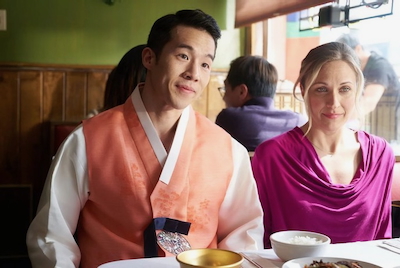
Winnipeg appears to be a favourite setting and site for Canadian films lately. Late years entry for the Canadian entry for the Academy Award for best International feature (though it did not make the shortlist), but the Winner won the Toronto Film Critics’ Association Best Canadian Feature, UNIVERSAL LANGUAGE and this film, THE MOTHER AND THE BEAR are both shot in Winnepg/
Two Canadian films will be released close to each other, b both of which share similar themes with a difference. The films referred to are THE MOTHER AND THE BEAR, th film reviewed in this article and MONTREAL, MA BELLE. The identical themes in both films are the mother-daughter estranged relationship. Also, one is gay and hidden, making the telaStionship even more troublesome. In MONTREAL MY BALLE, it is the mother, played by Joan Chen, who is gay, and in THE MOTHER AND THE BEAR, it is the daughter who hides her same sex orientation.
The beginning of THE MOTHER AND THE BEAR is the most original segment in the whole movie. The daughter sees a bear near a huge dumpster in the dead of winter, screams and slips. She is inn hospital. Was she attacked by the bear, or did she just slip on the ice? The girl is in a coma. As it turns out, director Johnny is the subject of the daughter to the mother.
Sara (Kim Ho-jung), a woman from South Korea, travels to Canada after her daughter Sumi (Leere Park), who had emigrated to Winnipeg some years earlier, is injured in a fall that leaves her comatose. Upon arrival, Sara discovers how little she truly knew about her daughter's life.
Sara despairs about her daughter’s single status, so she immediately starts catfishing the pleasant Min (Jonathan Kim) to be Sumi’s boyfriend — once she wakes up, of course — and also gets unwittingly entangled with Min’s estranged father, Sam (Won-Jae Lee), who runs a Korean restaurant in the city. As Sam and the widowed Sara connect over their mutual melancholies, a chance meeting with Sumi’s co-worker Amaya (Amara Pedroso Saquel) leads Sara to learn more about the life from which her daughter has chosen to exclude her.
Despite the common theme the film has with MONTREAL, MA BELLE, the themes of a meddling mother, a mother visiting Canada for the first time, and matchmaking are not new ideas. The audience can also find it difficult to sympathise with a bumbling, meddling mother who does harm, m like destroy another relationship, and lie her way around. Director Ma’s film is a quiet, pleasant one, but nothing fresh is0one display and watching the film plod along is a rather boring experience. One word, ‘meh’, can be used to describe the film. There is also a little tour of Winnipeg, of its budding, snowy and wintry streets that makes the film more like an advertisement for the Manitoba Tourist Board.
Performances are ok, and Kim’s performance seems like director Ma is directing it.
At Cinéfest, THE MOTHER AND THE BEAR won the award for Outstanding Canadian Feature. The film is scheduled for a **general theatrical release in Canada on January 9, 2026.
Trailer:
PEOPLE WE MEET ON VACATION (USA 2025) **
Directed by Brett Haley
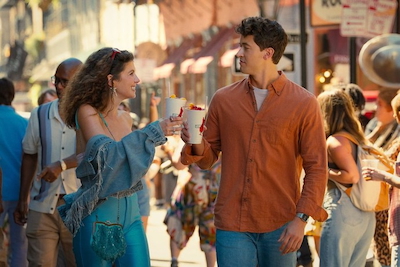
Rom coms are the least of my favourite movie genres. Typically, they are too predictable. The two first meet under unlikely circumstances, then fall into a possible romantic relationship. Then there is the obstacle, often concerning the past or some misunderstandigthat causes the two to argue and rift apart. But only to come together for a happy ending that often involves something ridiculous, like chasing the other before the plane takes off. But the Rock Hudson Doris Day matchup here is always a delight, with films like PILLOW TALK being a minor classic. This new rom-com from Netflix is based on People We Meet on Vacation, a romance novel by Emily Henry, published May 11, 2021, by Berkley Books, known as You and Me on Vacation in the UK and Australia. The book is a New York Times bestseller, and it would be interesting to see how the story is adapted for film.
People We Meet on Vacation is told in a nonlinear narrative (both novel and film), interspersing its protagonist's present vacation with flashbacks from past trips. It follows Poppy Wright (Emily Bader) and Alex Nilsen (Tom Blyth), two best friends who are opposites in every way. When the two first meet, they share a road trip, and he has a girlfriend. She is an outgoing, wanderlust-filled wild child, while he is mild-mannered and introverted. From the car/road trip, Poppy is shown to be terribly annoying, while Alex grins and bears it. Poppy spills food all over in the car, listens to loud and annoying music and chatters nonstop about nonsense. No one in their right mind would want a car companion like Poppy. Every summer, they come together for a week-long vacation, until a trip to Croatia causes them to stop speaking for two years. One can immediately predict that these two, Alex and Poppy, will live happily ever after, despite their initial hiccups.
Linfield is not the more famous Irish town, but a small town in Ohio, US, where Poppy and Alex are originally from.
How does PEOPLE WE MEET ON VACATION compare to say, the Rock Hudson Doris Day romantic comedies? For one, the latter are much funnier. Doris Day always plays the prude female, which is always so funny, with her expressions like “Ooooooo,” when she gets into an embarrassing situation. Everyone knows Rock Hudson is gay, which makes their films funnier. In PEOPLE WE MEET ON VACATION, the jokes are not funny and the jokes that Poppy cracks are more annoying to both Alex and the audience. And the film is already too predictable anyway. It does not help that the supporting characters, like Jameela Jamil with her plastic surgery, huge lips playing Poppy’s boss, Swapna Bakshi-Highsmith, are just as annoying, if not more.
The story is a variation of the old rom-com with Alan Alda and Ellen Burstyn, SAME TIME NEXT YEAR (1978), directed byRobert Mulligan, showing how their love develops. Only trouble is that the journey there is laddled with unfunny jokes and boring encounters.
PEOPLE WE MEET ON VACATION, the rom com has so far, obtained n the review aggregator website Rotten Tomatoes, 88% of 17 critics' reviews are positive. So, despite my bias against rom coms, this might be an entertaining bet for many. The film opens for streaming on Netflix on January 9th.
Trailer:
PRIMATE (USA 2025) ***
Directed by Johannes Roberts
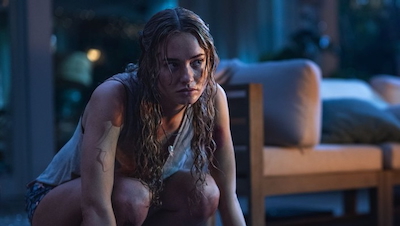
A tropical vacation goes awry when Ben, a family's adopted chimpanzee, is bitten by a rabid animal and suddenly becomes violent.
PRIMATE begins with a description of rabies and what rabies can inflict. It is a way filmmakers attempt to create credibility in a horror movie.
Rabies is a viral disease that causes encephalitis in humans and other mammals, such as chimpanzees, as seen in the film. It was historically referred to as hydrophobia ("fear of water") because its victims panic when offered liquids to drink. The characters in the story escape from the rabies chimp by treading water in the middle of the i house swimming pool, making the fact that th chimp cannot swim and is also afraid of water. So, this part is true.
Early symptoms can include fever and abnormal sensations at the site of exposure, which are followed by nausea, vomiting, violent movements, uncontrolled excitement, fear of water, an inability to move parts of the body, confusion, and/or loss of consciousness. All the symptoms except for the fear of water are used in the film. The time period between contracting the disease and the start of symptoms is usually one to three months, but can vary from less than one week to more than one year. The effect is immediate in the movie, with Ben experiencing the symptoms right after being bitten by an infected mongoose.
The film depicts a stunning Hawaii, where some of the characters are vacationing and where Lucy, the protagonist, is returning other poem, to see her deaf mute father and younger sister.
The deaf mute father injects a bit of variation into the movie. The handicap is used for both antipationa nd also for a bit of humour, judging from the laughs coming from the audience at the promoscreenong. Kucy is screaming when attacked by the chimp, while the father is oblivious to the occurrence, unable to hear anything.
The film succeeds in satisfying action-horror fans with formulaic action set pieces and a standard storyline, complete with an ending that is ripe for a sequel. PRIMATE is essentially an expensive Hollywood B-movie with the terrorising beast being a chimp with a severe case of rabies. Whether a rabid monkey is able to go through the lengths shown in the film at terrorising its human victims, or whether the monkey has sufficient strength, is immaterial, so long as jump scares abound and audiences are on the edge of their seats.
Johannes Roberts is an English filmmaker, best known for directing the horror films including Other Side of the Door (2016), 47 Meters Down (2017), The Strangers: Prey at Night (2018), Resident Evil: Welcome to Raccoon City (2021) and PRIMATE in 2025. At best, director Roberts can be credited for delivering one lean, mean, no-nonsense effective chiller.
January is the perfect month to open horror flicks. PRIMATE from Paramount opens widely in theatres on January 9th.
Trailer: