
FILM REVIEWS:
28 YEARS LATER: THE BONE TEMPLE (UK/USA 2026) ***
Directed by Nia DaCosta
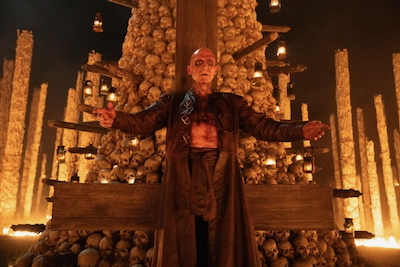
28 YEARS LATER: THE BONE TEMPLE is a close sequel to the previous 28 YEARS LATER that Danny Boyle directed. This latest film, not directed by Boyle but by Mia DaCosta, fails to bring in the details of the first film that would make this sequel more sense.
Taking place after the events of the previous film, Spike (Alfie Williams)is inducted into Sir Jimmy Crystal's (Jack O’Donnell) gang of acrobatic killers in a post-apocalyptic Britain ravaged by the Rage Virus. Meanwhile, Dr Ian Kelson (Ralph Fiennes) forms a new relationship with potentially world-changing consequences.
The film shifts among three main characters. One is Spike, renamed Jimmy, and how he copes with the horrors around him. Then there is the villain of the piece, Jimmy Crystal, whom Spike attempts but cannot escape from. Then there is the good doctor, Dr. Kelson wh finds his comfortable, or rather, settled lifestyle is being threatened and he finds himself in survival mode. The three are brought together with disastrous consequences resulting.
THE BONE TEMPLE fails to detail where Spike comes from. It also just mentions the origin of Jimmy Crystal, his introduction to the devil in a church with an inverted cross given to him by his dad, and fails to detail anything more. And where did Dr Ian Kelson come from? All the characters in THE BONE TEMPLE are present for no reason and interact without much expansion. All the explanations are done away with for the sake of a no-nonsense horror thriller, which will satisfy many fond of the horror genre, but the lack of a narrative is noticeable.
The great director Alfred Hitchcock said that he places segments in his movie tat has nothing to do with the film’s plot, sometimes just to give the audience a breather. This technique aids in a film’s pacing, which is noticeably absent in THE BOEN TEMPLE. Director DaCOST ups the ante at a constant madcap pace with no breather, resulting in an extremely intense film, with one horror occurring after another. This is not aided by Ralph Fiennes' manic performance, especially in his Satanic dance, which he goes all out in one of the film’s key scenes.
The first film shows, and this film should explain too, but does not, that in 2002, during the initial outbreak of the Rage virus, a young boy, Jimmy Crystal, flees his house in the Scottish Highlands as his family is attacked by the infected. He takes refuge in the local church with his father, a minister, but finds him praying in ecstasy because he interprets the virus as a harbinger of the end times. Jimmy's father bequeaths him a cross necklace and helps him to safety before submitting to the infected as they break in.
THE BONE TEMPLE also fails to reveal the film setting of the film, assuming that the audience knows it is in the U.K., and nothing is said of the virus’s spread in Europe. (The movie was filmed across northern England locations—such as North Yorkshire, Cumbria, and Northumberland). But as a lean, mean horror machine, director DaCost delivers her blood-soaked flesh gore fest with relentless pacing and conviction.
28 YEARS LATER: THE BONE TEMPLE opens widely in theatres January 16th.
Trailer:
CHARLIE THE WONDERDOG (Canada 2025/2026) ***
Directed by Shea Wageman

Cineplex Pictures has partnered with ICON Creative Studios to bring audiences Charlie the Wonderdog, a heartwarming new family adventure starring Owen Wilson, opening in theatres nationwide on January 16, 2026. When Danny’s family dog (voiced by Owen Wilson) discovers he has superpowers, Charlie sets out to fulfil his destiny and protect the people he loves — only to learn that real heroism comes from courage, kindness, and believing in yourself.
The story centres on Charlie, a beloved family dog who suddenly gains superpowers after being abducted by aliens and then returning home with abilities beyond a normal pup.
The story is simple and goes like this: Danny, a boy, receives a dog he names Charlie for his birthday. They become more like pals than master and dog. But as Charlie shows his age, Danny feels sad for him. But Charlie is abducted by aliens and attains superpowers. The villain is the cat next door, Puddy, who tries his best to destroy the Wonderdog.
When Danny tells his mum, “Charlie is really slowing down tonight. He can not make it up the stairs.” This truly is a dog movie. For those who own a dog, many scenes will pull at one’s heartstrings, no matter how corny they are. When Danny first sees Charles as a gift for his birthday, the dog, Charlie, responds by licking Danny all over his face. His response is to give the dog a big hug. Giving a dog a big hug is crucial to the love a human can show to a canine. (This reviewer knows, as he owns a dog himself, that hugging her countless times a day.)
The film is charming enough with occasional welcome bouts of humour and goodwill. The film begins to lag during the second half once Charlie starts saving human lives with his superpowers, while delegating audiences mainly at the film’s beginning, before Charlie grows younger and attains his superpowers. Corny as it sounds, at its heart, the film explores themes of courage, kindness, loyalty, and believing in yourself, delivering a family-friendly adventure with comedy, action, and heart.
The film strikes a good balance between the male and female genders. The hero is the boy and Charlie, but Danny’s mother also comes into the picture at the end, helping out as a kind of ‘super-mum’, as Danny’s mother is reputed to be able to fix anything.
You know this film works in that after watching it, you want to go home and hug your best caninefriend. Yes, and the film ends with Danny giving his dog, Charlie, a huge hug and saying: “It is just you and me, Charlie!”
Animation-wise, CHARLIE cannot be compared to the Disney or Pixar Studio animation, but the animation holds its own, with colours matching the alien promise with concentration on the details of the characters’ faces that highlight the emotions of the story.
CHARLIE THE WONDERDOG opens in theatres January 16th.
Trailer:
L’ETRANGER (THE STRANGER )(France 2025)N ****
Directed by Francois Ozon

L’ETRANGER (The Stranger) is touted as based on the novel of the same name by Albert Camus. For those unfamiliar with Camus, here is some important background on the French author. Albert Camus was a French philosopher, novelist, author, dramatist, journalist, world federalist, and political activist. He was the recipient of the 1957 Nobel Prize in Literature at the age of 44, the second-youngest recipient in the history of the award. His works include The Stranger (which is adapted into the film reviewed here), The Plague, The Myth of Sisyphus, The Fall, and The Rebel.
Director Francois Ozon, world-renowned French director of hits such as his latest QUAND VIENT L’AUTOMNE, and others like SITCOM, CRIMINAL LOVERS, 8 FEMMES, SWIMMING TOO and FRANTZ, to name a few. His films often contain a gay subtext, except for L’ETRANGER which is based on the celebrated, clearly heterosexual author Camus. Like many of Ozon’s other films, the main actor portraying the protagonist is a good-looking male.
Camus novel is a complex one that is filled with metaphorical themes such as survival in an absurdist conventional world, and where the protagonist lives out a life in which he is totally disinterested in.
The film follows the same pacing of Camus’ book, with the halfway mark of the film coinciding with the same mark in the book. The film begins with Meursault being led into prison and asked by fellow prisoners what he did. “I killed an Arab,” is his reply.
Meursault learns of the death of his mother, also at the start of the film, as the film flashesback (without the titles like ‘several weeks earlier’) to the incidents that got him arrested, who has been living in an old age home in the country. He takes time off from work to attend her funeral, but seems to show no signs of grief or mourning to the people around him. When asked if he wishes to view her body, he declines, and he smokes and drinks regular (white) coffee—not the obligatory black coffee—at the vigil held by the coffin the night before the burial with the caretaker. The day after the funeral, Meursault returns to Algiers and encounters Marie, a former secretary of his firm. The two become re-acquainted, swim together, and that evening watch a comedy film and begin to have an intimate relationship. Over the next few days, Meursault helps Raymond Sintès—a neighbour and friend who is rumoured to be a pimp, but says he works in a warehouse—to get revenge on a Moorish mistress, a task that leads to Meursault’s killing of the Arab.
Director Ozon moves his film at a pace that allows his audience to ponder over Camus’s story. Meursault finds peace by fully accepting the absurd nature of existence and the inevitability of death. Meursault is obviously “a stranger” to the society of French Algiers, but also to its societal values. His detachment reveals how social norms often prioritise appearance, sentimentality, and conformity over honesty. The film demonstrates that dignity, and especially freedom, come from honesty, confronting this fact rather than escaping it through false beliefs or social performance.
The film had its world premiere in the main competition of the 82nd Venice International Film Festival on 2 September 2025, where it was nominated for the Golden Lion. It was theatrically released in France by Gaumont on 29 October. It opens in Toronto this Friday, January 16th.
Trailer:
MALDOROR (France 2024) ****
Directed by Fabrice de Welz
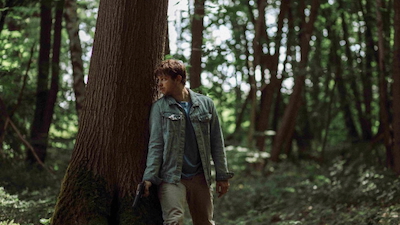
Arriving early 2026, and the best film of 2026 so far, MALDOROR is based on the notorious Marc Dutroux case that shook Belgium in the 1990s. The film follows a young police recruit who becomes involved in a special task force called “Maldoror,” created to track a suspected child predator.
The title of the film, MALDOROR, primarily refers to the villainous, evil protagonist in the influential 19th-century French prose poem Les Chants de Maldoror (The Songs of Maldoror) by Comte de Lautréamont, representing pure evil and defiance against God and humanity, with the name possibly meaning "Evil of Dawn" or "Bad Gift". The term is also used for a 2024 Belgian film, with a villain so evil that he depicts the description of MALDOROR.
Belgium, 1995. The shocking disappearance of two young girls leads to the formation of a secret police operation known as Maldoror. Newly recruited officer Paul Chartier is tasked with monitoring a dangerous suspect but soon finds himself in a losing battle against bureaucracy and systemic dysfunction. As official efforts collapse and the case is closed, still unsolved, Paul spirals into obsession, pushing him beyond legal and moral boundaries in a relentless pursuit of justice.
There are three threads in the narrative that propel the story along in the search for the child abductor. One is the conflict between three branches of the police, one the judiciary, the other the local, and the other the federal. Another thread is the relationship problems that arise from Paul’s obsession with his case. His newlywed wife is expecting a baby, and he is too involved to spend time with his family. When things reach a boiling point, the wife leaves him. At another confrontational segment, Paul blames his wife for the two kidnapped girls being murdered. The audience sees both sides of the argument, and while one feels sympathetic towards Paul, Paul is not always right. The third part of the story is the hunt for the kidnapper while uncovering a hidden network of human trafficking. Incredibly, all the events are based on a true crime that happened in Belgium.
Anthony Bajon is nothing short of excellent in the role of the obsessed gendarme. He is not Mr Handsome, but suits the role of a small-time gendarme. Alexis Manenti is also very good as Luis, Paul’s partner. Manenti was in LES MISÉRABLES in 2019, where he played a racist cop.
The brilliant, well-acted film of an obsessed small-time gendarme hunting down a child kidnapper, combining the themes of systemic police corruption and indifference, the personal toll of pursuing evil, and the topic of vigilante justice,e all add up to make MADOROR a film to be reckoned with.
The film has won accolades at international film festivals, including:
Sitges-Catalonian International Film Festival (2024) | Nominee, Best Film
Lisbon Film Festival (2024) | Nominee, Best Film
Ghent International Film Festival (2024) | Nominee, Best Film
Festival Européen du Film Fantastique de Strasbourg (2024) | Winner, Crossovers Competition
Fantasy Filmfest (2024) | Nominee, Jury Prize
The film premiered on 3 September 2024 at the 81st Venice International Film Festival. It was theatrically released in France on 15 January 2025 and in Belgium on 22 January 2025. For the U.S. and Canada, MALDOROR arrives on VOD/Digital Platforms on 1/16 from Film Movement.
Trailer:
THE RIP (USA 2025) ***
Directed by Joe Carnahan
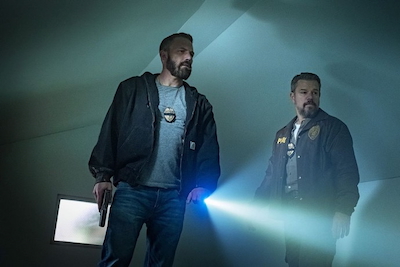
January marks the end of the Quality Award movies every year. What follows every year, then, are expensive or mid-range budget horror or action films to lure audiences to the cinema. As for action, there are already 28 YEARS LATER: THE BONE TEMPLE and PRIMATE. Now come the action films like the upcoming Chris Pratt sci-fi flick MERCY and Jason Statham in SHELTER. Also on the radar is a Netflix film to be seen on the big home screen, another high-octane action film starring Matt Damon and Ben Affleck in a crooked cop movie based on true events, entitled THE RIP. Directed by Joe Carnahan, who directed in 2006 one of my favourite fucked up films called SMOKIN’ ACES that I adored, but most other critics hated. The RIP puts Cagayan again in the action good books. Director Carnahan delivers what is expected, an expensive action flick with enough action set-pieces, with a crime story to boot, that should satisfy action fans who do not demand too much from their film-going.
What is a RIP? It does not mean Rest in peace but a modern use of the word related to crime. According to the Oxford dictionary, rip means to tear or pull (something) quickly or forcibly away from something or someone. In the film, rip refers to the stash of money discovered in a stash house.
The story follows a team of Miami police officers who, during a narcotics operation, discover a huge stash of money—far more than expected—hidden in a rundown stash house.
When they find millions in cash (around $20 million), the situation quickly escalates. The officers must count and secure the money on site, as required by law, while trust begins to break down among the team. As outside forces (including other law-enforcement agencies and criminal elements) learn about the massive seizure, the cops start to question loyalties, motives, and even each other, raising the central theme of corruption vs. integrity in law enforcement.
The film has a fast-paced, gritty, tense crime thriller with action and moral ambiguity, with dead seriousness replacing comedy that is noticeably absent in the film. The dark and moody atmosphere, with most of the action taking place at night, enhances the mood of the film.
The film only reveals halfway through the film whether the cops are crooked or not, with the notion that some cops are more crooked than others. The story then moves into an all for oneself and screw whoever else.
THE RIP should attract lots of viewers on Netflix with star names like Ben Affleck and Matt Damon. Steven Yuen (from MINARI and MICKEY 17) also stars as a fellow cop. It is also the most expensive film directed by Carnahan, who has done a decent job on the action flick.
THE RIP opens for streaming on Netflix Friday, January 16th, and should have the number 1 film watched on the streaming service this weekend.
THE TESTAMENT OF ANN LEE (USA/UK 2025) ***
Directed by Mona Fastvold
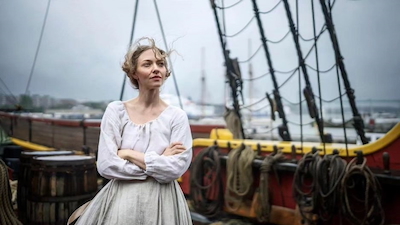
The film THE TESTAMENT OF ANN LEE is about Ann Lee, the founding leader of the Shaker Movement, with certain liberties taken by writer/director Mona Fastvold (THE BRUTALISTS). Ann Lee has been proclaimed as the female Christ by her followers. The film depicts her establishment of a utopian society and the Shakers' worship through song and dance, based on real events.
Ann Lee, commonly known as Mother Ann Lee, was the founding leader of the Shakers, later changed to United Society of Believers in Christ's Second Appearing, following her death. She was born during a time of the Evangelical revival in England and became a figure who greatly influenced religion at this time, especially in the Americas.
The film follows the start of the Shakers. In 1774, after nearly two decades of participation in a religious movement that became the Shakers, Ann Lee and a small group of her followers emigrated from England to New York. After several years, they gathered at Niskayuna, shown in the second half of the film, renting land from the Manor of Rensselaerswyck, Albany County, New York (the area now called Colonie). They worshipped by ecstatic dancing or "shaking", which resulted in their being dubbed the Shakers. Ann Lee preached to the public and led the Shaker church at a time when few women were religious leaders. She was often referred to and considered the female representation of God.
The ecstatic dancing with arms flailing together, with their shouting and what is called ‘singing’, all looks quite weird, not only for the non-followers but also for the audience of the film.
Ann Lee is also known as, as is also the film’s alternative title, THE WOMAN CLOTHED BY THE SUN WITH THE MOON UNDER HER FEET.
The film opens in the 18th century in Manchester, when Ann was a child, shown with her brother William. Lots of voiceover. The voiceover aids in putting the story in perspective, especially when dialogue cannot always tell the whole story or emotions accurately.
The film can be divided into two parts: the first set in Manchester and the second in America, where Mother Ann travels with her followers to spread her beliefs.
Composer Daniel Blumberg (collaborating the second time with the director) researched the many, many Shaker hymns and wrote three original songs for the film. Film editor Sofía Subercaseaux worked closely with the music edits to put the dances and musical numbers together. One can also see from the editing that the tone in the second half is tighter and more contained than raw compared to the first half.
THE TESTAMENT OF ANN LEE is a film about faith, the Christian faith with a difference. Though one might call hot a cult, Ann Lee preaches God as in Jesus, and so refutes a lot of her persecutors’ accusations. The shakers were never ridiculed in the film, but more humanised. Opening originally at Christmas, this ‘Christian’ film is not the typical type, and thus been rescheduled for an opening this week.
Trailer: