
BEST BETS for the week:
BLOOD LINES
DISCLOSURE DAY
SHOOT THE PEOPLE
IN THE HAND OF DANTE (Netflix)
PETER ASHER: EVERYWHERE MAN
FILM REVIEWS:
BOUCHRA (Morocco/Italy/USA 2025) **
Directed by Orian Barki and Meriem Bennani
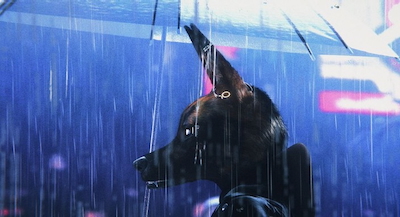
The beginning sequence of the fresh and inventive film BOUCHRA, shot in French, English, and Moroccan, has the word Casablanca appearing on th screen, then followed by the words New Your. The audience sees a NYC subway train flying by, and an image can be seen. The image forms into acid to animal, later revealed to be a coyote named BOUCHRA, also the name of the film. What initially looks like a horror movie then settles to be playful animation drama,
BOUCHRA tells the story of a queer New York filmmaker’s conversations with her mother in Morocco. A film that combines documentary techniques with an inventive narrative structure and uses 3D animation would be enough to make it a unique work. But what makes it a singular piece is its disarming and affecting honesty, its surrealism belied with deep reality issues and emotional drama.
Thirty-five-year-old Bouchra, a Moroccan filmmaker living in New York, has reached an artistic dead end. She sits in front of an unfinished screenplay, unable to decide how to tell the story of her journey from Casablanca to New York or how honest she should be about her life as a queer woman. The film she wants to make is autobiographical, but painful memories and unresolved family issues leave her creatively paralyzed. As obvious and predictable in this kind of art feature, the film BOUCHRA wants to make is the one the audience sees. Does the audience care? Orian Barki and Meriem Bennani do their thing and do not bother with whether the audience cares or not. They just tell their story in their own way, which makes the film both fresh and interesting to non-commercial audiences and frustrating and a tad confusing for commercial audiences,
The confusion and freshness of the film compete as the narrative constantly shifts between Bouchra's present-day life in New York, scenes from the film she is trying to create,
memories of growing up in Morocco, and actual-style phone conversations with her mother. One scene, when Bouchra is talking to her mother while making a dish in the microwave, is distracting and annoying. The fact that Bouchra does not don a human face also does not allow her character to express emotions
In the real world, Bouchra’s life in New York, Bouchra continues living within New York's queer artistic community. She spends time with friends, goes to clubs, has romantic and sexual relationships, and discusses filmmaking with collaborators. Yet despite this freedom, she still hides important parts of her life from her mother. The contrast becomes one of the film's central tensions: New York represents self-expression. Casablanca represents family, tradition, and unresolved emotional ties.
The many questions raised in the film are left hanging, as expected in art films where the solution is not the goal but the journey towards it. Does Bouchra reconcile with her mother, who, with her father, kicked her out when she came out as gay? Does Bouchra succeed in making her film? How does her settling in New York as a queer immigrant end up, and how does Boxcar reconcile the two cultures? This results in an artsy, confusing, and annoying film despite its different approach,
BOUCHRA opens July 3rd at the TIFF Lightbox with limited screenings.
Trailer:
ENOLA HOLMES 3 (UK 2026) ***
Directed by Philip Barantini
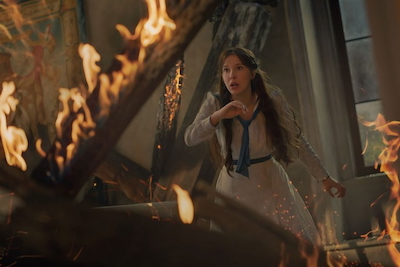
To those unfamiliar with the character of Enola Holmes, Enola is also a brilliant detective and sister of Sherlock Holmes.
Enola Holmes is an American mystery film franchise created by Harry Bradbeer and Philip Barantini that has been produced by PCMA Productions and Legendary Pictures in association with Netflix since 2020. The films in the franchise include Enola Holmes, Enola Holmes 2, and Enola Holmes 3.
The first two films are directed by Harry Bradbeer, and the third film is directed by Philip Barantini. All films are written by Jack Thorne and star Millie Bobby Brown as Enola Holmes, the main protagonist of the series.
This film begins in Malta, where Enola Holmes and Lord Tewkesbury have arrived for their wedding. The ceremony is being held there because Tewkesbury’s late father served in Malta during the British occupation, and his mother believes it is the most meaningful place for the family. Sherlock attends but is openly against the marriage, believing Enola is sacrificing her independence to become a Lady. Enola insists she can be both a wife and a detective.
Meanwhile, Sherlock is secretly working on another case. Before he can explain it to Enola, he disappears. At the same time, a dying Maltese soldier mutters what sounds like “wrath.” Enola later deduces he actually said “Rathe,” the surname of someone important. The soldier had been searching for Professor Adeline Rathe, believing she supported Maltese independence from Britain. Searching Sherlock’s room, Enola finds a torn piece of an expensive woman’s dress. She tracks the woman through Valletta, but before she can question her, the woman is shot by a sniper. As she dies, she warns Enola, “She will kill you.” Enola pursues the assassin but loses him. And the intrigue and action continue.
ENOLA HOLMES, unlike the other Sherlock Holmes films (except for one, Billy Wilder’s excellent THE PRIVATE LIFE OF SHERLOCK HOLMES), is played mostly for laughs. From the beginning, with comical narration such as how good stories always begin with a wedding, there is much humour, good solid English humour in this one. For example, the carnival in Malta is exceptionally subtly funny if one looks loosely at what is on parade and the reactions of the people there.
There are also some snide comments about the British in Malta. Enola is told that the British are not welcome in Malta, as they get the Maltese to fight and die in the British battles while not understanding how to run their country. The film was shot at the Shepperton Studios as well as on the island of Malta.
There are three reasons to watch ENOLA HOLMES 3. Firstly, it is based on the popular mystery series books by Nancy Springer. The second is that Enola is the sister of Sherlock Holmes in the franchise, Sherlock being the world’s greatest detective. With the Sherlock Holmes stories by Sir Arthur Conan Doyle comes all the familiar characters, including Dr. Watson and villain Professor Moriarty, both of whom also appear in ENOLA HOLMES 3. Thirty and most important reason of all is that ENOLA HOLMES 3 is directed by British filmmaker Philip Barantini, winner of 2 EMMY Primetime Awards, and who directed the miniseries ADOLESCENCE in 2025, one of the best series ever!
ENOLA HOLMES 3 opens for streaming on Netflix July 1st.
Trailer:
PETER ASHER: EVERYWHERE MAN (USA/UK 2025) ***1/2
Directed by Daniel Geller and Dayna Goldfine
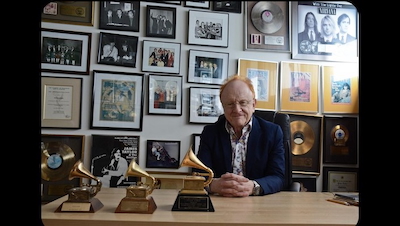
Who is Peter Asher? Those in the music industry, and anyone who is a singer/songwriter, would definitely know. He is a smart man, for one, immensely talented and musical. And this documentary, which brings one back to the nostalgic 1960s, does this gentleman justice.
PETER ASHER: EVERYWHERE MAN is a feature-length documentary inspired by musician, producer, and manager Peter Asher’s celebrated cabaret show A Musical Memoir of the ’60s and Beyond. Like his stage performance, the film traces an extraordinary life lived at the center of modern music history. From his early years as a child actor in 1950s London to the Swinging Sixties, Asher emerges as a Zelig-like figure in the culture of the era: one half of the pop duo “Peter and Gordon,” recipients of four chart-topping hits penned by Paul McCartney; the first head of A&R at Apple Records; and co-owner of the Indica Gallery, the epicenter of London’s countercultural art scene. Asher helped define a generation of singer-songwriters as producer and manager for James Taylor, Linda Ronstadt, and others, cementing his reputation as one of music’s most influential behind-the-scenes forces of the 1970s and ‘80s. In the present day, he remains a vital creative force, still performing, producing, and most recently collaborating with Barbra Streisand on her acclaimed The Secret of Life duets album.
The doc unfolds with Peter giving a talk about his achievements on stage. The doc unfolds in chronological, a way this reviewer prefers, instead of distracting over-styled ways.
Asher was born at the Central Middlesex Hospital to Richard and Margaret Asher, née Eliot. His father was a consultant in blood and mental diseases at the Central Middlesex Hospital as well as being a broadcaster and the author of notable medical articles. Asher's mother was a professor at the Guildhall School of Music and Drama. One of her pupils there was George Martin.mm Asher is the brother of Clare Asher, a radio actress and school inspector, and Jane Asher, an English actress and author.
One of the best things introduced in the docs the song, a hit written by Paul McCartney for the duo Peter and Gordon, a song that they performed. The song is called “A World Without Love,” performed by the duo; a song that made it to number one in the UK charts, then the European charts, and then the American charts. The song can be heard on YouTube, and I have played it several times already as it is such a beautiful and nostalgic song,
Quote: a bit of the doc is devoted to the duo of Peter and Gordon. They were classmates and, in Peter’s words, the only other schoolmate that’d a guitar. As the story goes, they hooked up, formed a duo, and because ver popular locally. Gordon, according to Peter, was the handsome one, and he was also the wild, angry, and more ill-disciplined one. Peter was known as the intelligent one.
PETER ASHER: EVERYWHERE MAN is a beautifully put-together documentary that celebrates the music and songs of the 60s’s. It is so entertaining as it shows how Peter Asher wove his way around to become a successful record producer while working with celebrities like James Taylor, Carole King, and Linda Ronstadt, among others. Of court the Beatles are also on display. Though the doc drags on a little in the middle, watching the entire film is indeed a wonderful experience.
Trailer:
ROMERIA (Spain/Germany 2026) ***
Directed by Carla Simón
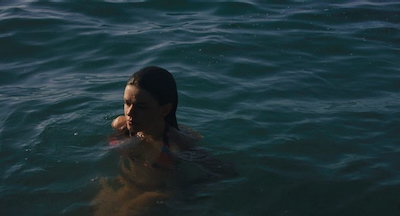
The film is shot in Vigo, where the story is set, the place where the protagonist Marina travels to find the truths behind her mother and father. The film portrays the beauty of Vigo with its sunshine and beaches, clear waters for swimming, and beautiful archaic architecture. Vigo is a city and municipality in Spain, in the autonomous community of Galicia in the province of Pontevedra, and the capital of the comarca (comarcas are divisions of Vigo) of Vigo. Located in the northwest of the Iberian Peninsula, it sits on the southern shore of an inlet of the Atlantic Ocean, the Ria de Vigo, the southernmost of the Rías Baixas. The film promotes the city, clearly one to be visited.
As Marina explores Vigo, she reads passages from her mother's diary.
The diary paints an entirely different picture.
Instead of the cautionary tale described by her father's relatives, Marina discovers a passionate love story between two young people who dreamed of escaping ordinary life before addiction overwhelmed them.
Marina is young at 18 and subject to the pains of first love. During her stay, Marina develops a tender attraction to one of her young cousins. Their relationship remains restrained and somewhat ambiguous, but emotionally it becomes important. In the film, the romance is used to allowsMarina to imagine how her own parents may have fallen in love decades earlier.
This emotional parallel shifts the film away from straightforward realism into something more poetic.
The film contains a few sensitive and moving moments. The one where grandfather Alonso gives Marina money for her former cinema studies so she does not need to go through the trouble of winning a scholarship is one that stands out. “That is not why I am here (to Vigo), “ is her reply- an answer that explains a lot to the audience,
The film basically is about a girl who travels to visit her extended family to find out the truth about her parents, her parents who were drug addicts and who died of AIDs, a disease shameful at the time, and also still shameful now. The family tried to hide the fact from the folks of Vigo, a city in which rumours spread. There is really nothing wrong with the film, but it moves at a slow pace, often too slow for anyone’s patience. One has to be patient to see how the story unravels and how emotions are felt.
The second half of the film is more fantasy as Marina imagines her parents, who then appear on screen. They are shown, sometimes with Marina present as well, as free spirits who love each other tremendously while experimenting with all the different drugs they can find.
Eventually, Marina finds out more than she knew at the beginning of her parents, though her extended family gives her different accounts of them. It's up to Marina to put the pieces together and decide which are more accurate. The film ends with a happy and contented Marina, which is expected when she finally accomplishes the task of discovering her parents.
ROMERIA opens in theatres July 3rd.
Trailer: