JINGLE BELL HEIST (USA 2025) ***1/2
Directed by Michael Fimognarit
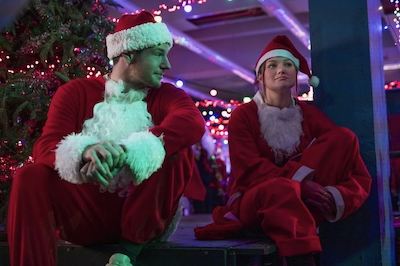
One good thing about CHRISTMAS DAY HESIT is that the film is set in London, the world’s renowned Christmas city. Note that to give a more modern look, there's a shot of the more newly built Overground train instead of the Underground train moving along the railway tracks in London. Written by Amy Reed and Abby McDonald, the film has a female slant, concentrating on one of the robbers, Sophie.
The story follows Sophia (played by Olivia Holt) — a resourceful retail worker struggling to make ends meet — and Nick O'Connor (played by Connor Swindells) — a down-on-his-luck repairman-turned-ex-security-consultant. Both are financially desperate when the Christmas season hits. With nothing to lose, the two independently plan to rob a luxurious London department store on Christmas Eve, each seeing it as their chance to escape hardship.
At the height of the holiday season, two strangers team up to rob one of London's most famous department stores while accidentally falling in love. The “department-store” in Jingle Bell Heist was — at least for filming purposes — represented by Loughborough Hotel in Brixton, London. The film’s production team dressed the hotel’s façade and ground-floor spaces to look like the fictional “Sterlings London Department Store.So while the story depicts a large, posh department store, the “store” in reality was a converted historic building — not a functioning retail department store.
The jokes are pleasant, not overtly funny, but still can manage a chuckle or two. Example in the huge departmental store, with a layout similar to Harrods, Sophie, who works there, encounters an irate customer who remarks: This place gets worse every day, to which a store clerk replies: Or the people. Sophie replies: Or is it that they were always terrible? The store manager who stands on he balcony overlooking the shoppers remarks: Shopping and spending! That is what Christmas is all about.
The filming locations are in the U.K., the film’s country of origin is the United States, which is obvious from the captioning spelling of the short form ‘mom’ instead of ‘mum’. At least the script uses the correct British terms like ‘last orders’ for ‘last call’, and ‘tube’ for ‘subway’. (Hey, I have spent over 2 dozen visits to London, even spending a number of Christmases there) Unfortunately, in the film every everyone at the Sterlings store wishes each other Merry Christmas. In London, everyone greets with Happy Christmas, not like in the United States.
For a Netflix Christmas movie, JINGLE BELL HEIST hits all the right notes. Do not dismiss this film as the typical Christmas nonsense that new films are usually released at this time of year. Though not the almost perfect Christmas film, it comes entertainingly close, and it does succeed as a romantic comedy, a heist job, and with a few messages put in for good measure. There are a few good twists in the plot that should satisfy even the more demanding moviegoer. The movie blends lighthearted romance and holiday spirit with suspense and moral complexity — the desperation of the protagonists makes their plan feel sympathetic rather than purely criminal.
JINGLE BELL HEIST opens for streaming this week on Netflix and makes an excellent festive fare.
Trailer:
MEADOWLARKS (Canada 2025) **
Directed by Tasha Hubbard
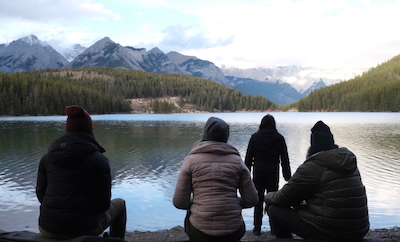
MEADOWLARKS is based on director Hubbard’s 2017 documentary Birth of a Family. Director Hubbard’s Meadowlarks is an emotional, fictionalised true drama that follows four siblings, separated by the Sixties Scoop, as they come together over a week. Sixties Scoop refers to the term given for the then-common practice of removing Indigenous children from their families, often without consent, and placing them with the child welfare system. There are no fewer than 3 Canadian films dealing with his topic at TIFF this year. Instead of dealing of issues like how the siblings got to each other and reunite, how they got taken away, director Hubbard concentrates more on awkward small talk, gifts, and forced bonding events, the one brother and three sisters do their best to get to know one another after decades apart, their interactions, and how they come to terms with one another. Unfortunately, Hubbard stays on melodrama and emotional theatrics to tell her story, resulting in forced sentiment and overlong hugging and screaming sessions that go on with dysfunctional families that one has already seen too much of. The audience is also forced to sit through one of the siblings, Justine’s full rendition of her ‘throat singing’.
SAVAGE HUNT (USA 2025) **
Directed by Roel Reiné
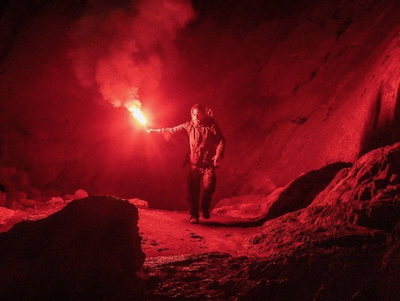
SAVAGE HUNT is a savage man versus beast thriller (touted as a survival thriller) from celebrated Dutch action filmmaker Roel Reiné, who also did the music of the film.
Driven by what the press notes call edge-of-your-seat suspense, tension, and primal stakes, SAVAGE HUNT follows a vengeful tracker who is brought in to hunt down a large grizzly bear that had begun attacking humans when a new local resort is being built.
The film’s touted to include scenes with a real grizzly bear. But the bear is not in all the scenes, with some computer-generated or animated, and the attacks often look quite tacky. In Hitchcock’s thriller, THE BIRDS, and in Spielberg’s JAWS, the first scene of a bird and of the shark only appears halfway through the movies, thus generating much audience anticipation. In SAVAGE HUNT, the bear is seen in the first scene and again in too many scenes that the bear looks too cartoonish in parts. But worse of all is the film’s continuity, not helped by the editing, which is really bad. Often, the audience sees the bear attacking a human on the ground and then sees it standing upright, roaring, and then rolling again on the ground. The bear attack scenes are shot with different camera angles of attack, which look disjointed.
The story takes place in the Montana wilderness, where the construction of a new resort and logging operations disrupt the natural habitat. There are some beautiful shots of the Montana landscape, including the rivers, mountains, and wilderness, making Montana look like a tourist spot to visit. But as modernization comes to the wild, the film’s premise proposes that the wild animals have nowhere to survive and therefore move closer to the towns. Such is the main grizzly bear in the film, which is described as the grizzly of grizzlies. If you think that this kind of bear that would eat scraps out of trash cans, this one would eat these grizzlies. T segments of the bear mauling her victims are not that frightening, and in fact, it looks kind of fake, though the aftermath of the mauling is shown in nasty detail to make the film’s point.
The film’s main character is Joe Regan, a hardened tracker and skillful hunter with a troubled past, who hunts down the bear. He has lost his son and his marriage as a result. Other characters include a resort construction chief with his estranged ex-wife and daughter, whom he is trying to communicate with. All these characters are essentially time fillers in a film with a thin narrative.
The film suffers from poorly executed action set pieces, though touted that a real grizzly was brought into the filming. The continuity is much worse, and coupled with a cliched story of relationship-troubled characters, SAVAGE HUNT fails to entertain in more ways than one.
SAVAGE HUNT arrives on digital download and on-demand December 2, 2025, from Shout! Studios, a Radial Entertainment Company.
Trailer:
THE STRINGER: The Man who Took the Photo (USA 2025) ***
Directed by Bao Nguyen
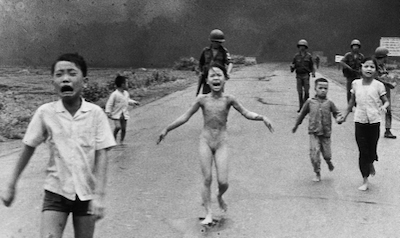
This Netflix doc concerns one of the most famous war photographs taken of all time. The photo shows a Vietnamese girl running naked from a napalm bomb, her skin peeling from her body as she ran. Phan Thị Kim Phúc OOnt, referred to informally as the girl in the picture and the napalm girl, is a South Vietnamese-born Canadian woman best known as the child depicted in the Pulitzer Prize–winning photograph, titled The Terror of War, taken at Trảng Bàng during the Vietnam War on June 8, 1972. The photo won Nick Ut the Pulitzer Prize, and the photo bore the reputation of peace, stopping the war.
But did Ut take the photo?
A stringer is a freelance reporter or photographer who contributes stories, photos, or videos to a news organization and is paid per piece rather than being on staff.
The Associated Press (AP) editor at the time claimed that it was his boss, Horst, who made him list the name Nick Ut as credit. The film is that story.
The central premise of the film investigates whether the famous Vietnam War photograph known as The Terror of War — more commonly called “Napalm Girl” — was actually taken by Nguyễn Thành Nghệ, a Vietnamese freelance photographer (stringer), rather than by Nick Ut, the person long credited with it. The film follows a two-year investigative effort led by conflict photographer Gary Knight and a team of journalists, starting from a confession by a former Saigon photo editor. That editor — after more than 50 years — claimed he was haunted by the knowledge that the photo might have been miscredited.
The issue of photo/film credit might seem trivial to some. But the film demonstrates otherwise. Beyond authorship, the documentary argues this revelation raises questions about how war photography — and those who risked their lives to capture it — have been credited, especially local and freelance journalists whose contributions may have been overlooked or erased.
The feel of the film is gripping and urgent, making the doc an absorbing piece of investigative journalism. The film challenges decades of established journalistic history by claiming that journalism for the photo may have been wrongly assigned.
But the truth is still up for debate. Not everyone is convinced: The Associated Press (AP) — which long credited Nick Ut — has strongly rebutted the documentary’s claims. Multiple sources from 1972, including colleagues and witnesses, continue to support Ut’s authorship. AP’s stance: without conclusive new evidence, they believe Ut remains the rightful credit.
The question then is, when a stringer sells a photo, does he sell his rights as well? If the rights are not mentioned, it could be argued that the rights had been sold as well.
`The film also raises broader, systemic questions about how local and freelance journalists — often working under dangerous, exploitative conditions — have been marginalized, their contributions erased or miscredited.
The film premiered at the Sundance Film Festival in January 2025 and has since been acquired by Netflix. The film is currently streaming beginning this week on Netflix.
Trailer: