
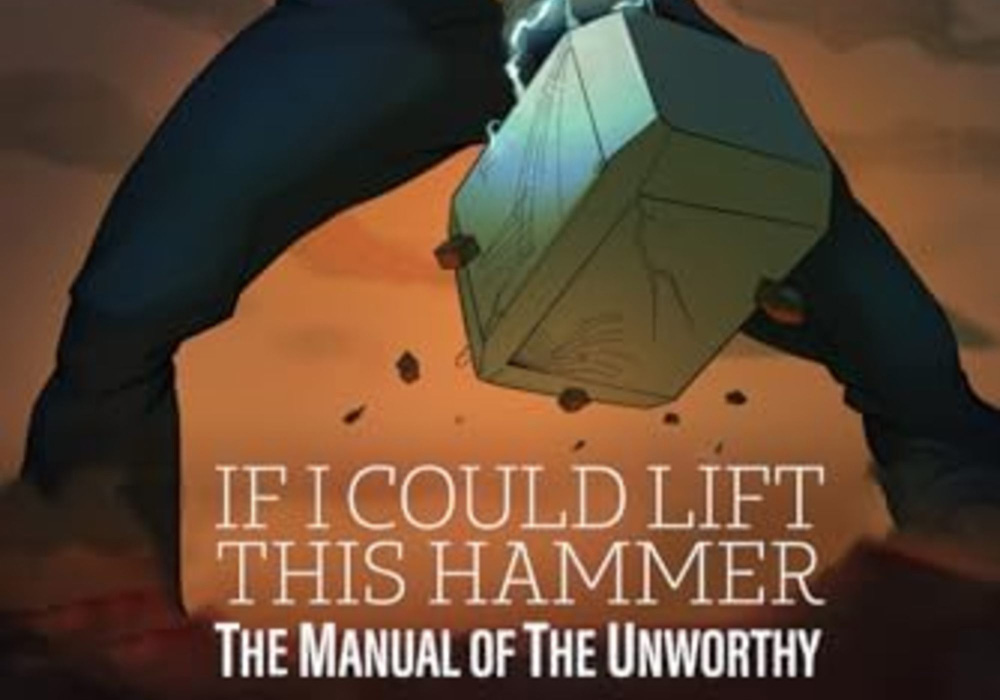
Melvin D. Bakandika’s If I Could Lift This Hammer explores worthiness through myth, memory, and cultural symbolism. The book invites readers to reconnect with an intrinsic sense of self-worth that was never meant to be earned.
In a cultural moment shaped by comparison, performance, and constant validation, conversations about self-worth often feel transactional. We are encouraged to prove ourselves, to earn legitimacy, to measure our value through productivity, visibility, or approval. If I Could Lift This Hammer, the debut book by Melvin D. Bakandika, takes a different approach.
Rather than offering strategies for self-improvement, the book asks a more foundational question: What if worthiness was never something we had to earn in the first place?
Blending mythology, popular culture, spiritual reflection, and lived insight, Bakandika presents the book as a “manual of the unworthy.” The phrase is intentionally provocative. It invites readers into a space many quietly inhabit but rarely name. From the opening chapters, it becomes clear that this is not a book about inadequacy. It is a book about remembrance. About reconnecting with an intrinsic sense of value that often gets buried under fear, shame, and inherited narratives.
The Lion King moment that says everything
One of the book’s most resonant passages draws on an unexpected but profoundly familiar source: The Lion King. Bakandika recalls the scene where Mufasa appears to Simba and tells him, “You have forgotten me; therefore, you have forgotten yourself.” As a young viewer, he sensed that the moment carried a weight far beyond animation. Years later, while writing this book, he recognized why.
Simba’s struggle is often misunderstood as a quest to prove himself. In reality, it is about remembering who he is. He does not become worthy through action or achievement. He reclaims his worth by reconnecting with his identity. Bakandika uses this moment as a powerful metaphor for how self-worth operates in real life. We do not suddenly become worthy one day. We forget our worth under layers of fear, social pressure, and expectation. The real journey is not acquisition, but remembrance.
This framing runs throughout the book, grounding philosophical insight in stories that feel accessible, emotional, and lived-in.
Unpacking the idea of “unworthiness”
From the outset, the title establishes the book’s willingness to confront uncomfortable ideas about value and self-perception. Bakandika is clear that he does not believe true unworthiness exists. Yet he understands how deeply many people carry that feeling. By naming it, he opens a door to conversations that are often avoided because they feel uncomfortable or shameful.
Rather than centring on what is “wrong” with us, the book examines how beliefs about ourselves are inherited and reinforced. Family narratives, cultural conditioning, and societal metrics of success shape how we see ourselves, often without our conscious consent. Bakandika argues that whatever we believe about ourselves becomes our truth, which raises an important question. If beliefs are learned, they can also be rewritten.
He points to collective examples of transformation, including how Diasporic African communities reshaped narratives of identity and power in the face of historic trauma. The implication is clear. Personal worth, like collective identity, can be reclaimed through intention and belief.
Being worthy vs. being worthy of it
One of the book’s most important distinctions is between “being worthy” and “being worthy of it.” In a world driven by validation, metrics, and external approval, the difference matters.
Being worthy is intrinsic. It exists regardless of achievement, status, or recognition.
Being worthy of it is conditional. It is negotiated through external standards that constantly shift.
Bakandika’s writing challenges readers to step away from fragile systems of validation and return to an internal sense of grounding. The tone here is not prescriptive or preachy. Instead, it feels like an invitation to pause and reconsider what has been accepted as normal.
A manual, not a manifesto
Stylistically, If I Could Lift This Hammer balances philosophical depth with clarity and restraint. Bakandika chose to structure the book as a manual, keeping chapters concise and reflective rather than exhaustive. He cites inspiration from works like Paulo Coelho’s Warrior of the Light, favouring insight over volume and resonance over argument.
The result is a book that feels accessible without being simplistic. Myth and metaphor sit comfortably alongside everyday language. The prose carries a quiet poetic rhythm that mirrors the subject matter itself. Worthiness, as Bakandika presents it, lives somewhere between the mythic and the mundane.
The ideal reader is not defined by age, background, or profession. It is anyone who feels curious, searching, or slightly untethered. Anyone who senses there is more within them than they have been taught to claim.
Writing as an act of worthiness
Interestingly, Bakandika does not frame the book as a personal memoir, yet writing it reinforced something essential for him to. Completing the book was itself an act of worthiness. Not because it was perfect, but because it was finished, shared, and offered with honesty.
That perspective aligns seamlessly with the book’s message. Worth is not granted by reception or acclaim. It exists in the act of showing up fully and truthfully.
Why this book matters now
As mentioned in the introduction to this article, in a time when screens, metrics, and comparison increasingly shape identity, Bakandika’s work feels especially timely. Social media encourages constant measurement. Approval is quantified. Self-image becomes fragile. Against this backdrop, If I Could Lift This Hammer offers something quietly radical—a return to internal foundations.
Bakandika does not promise transformation through hustle or reinvention. He offers something more enduring: a reminder.
You are not required to earn what you already are. You only need to remember it.
If I Could Lift This Hammer is not a book about becoming a hero. It is about recognizing that you already are one, even if you forgot along the way.