
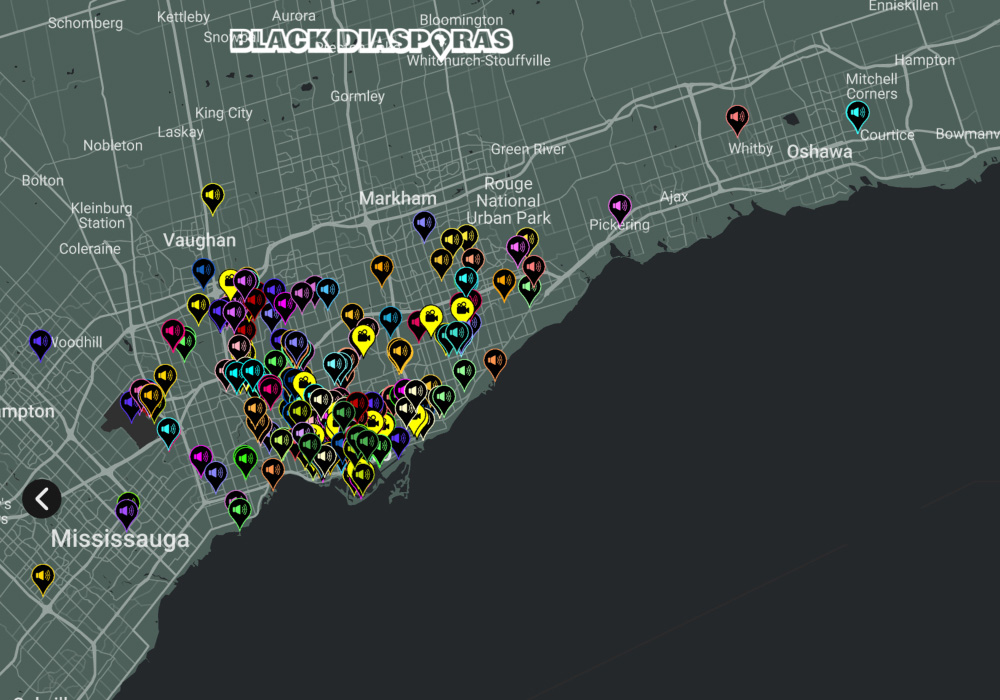
Over 500 oral histories trace Black Toronto’s joy, memory, and resistance. An immersive Queen’s Park exhibit brings the archive to life.
At Queen’s Park this week, the stories of Black Toronto are unfolding in the Lieutenant Governor’s Suite, carried by voices spanning generations, neighbourhoods, and lived experiences. For three days, from February 11 to 13, the exhibition Black Diasporas Tkaronto-Toronto transforms a historic provincial space into a living archive of joy, resilience, memory, and truth. It is an invitation to listen closely to the everyday moments and defining milestones that have shaped more than 265,000 people of African descent who call this city home.
Presented by afrOURban in collaboration with the Office of the Lieutenant Governor of Ontario, the Archives of Ontario, and the Canada Black Music Archives, the installation brings together film, oral testimony, and archival collections in one immersive setting. Anchored during Black History Month, the exhibition affirms that Black presence in Toronto is layered, dynamic, and foundational to the city’s past and future.
A map built from memory
At the heart of Black Diasporas Tkaronto-Toronto is a digital map and physical archive shaped by twelve commissioned short films and more than 500 oral histories. The project references long-standing oral traditions within African and diasporic cultures, centring storytelling as a method of knowledge sharing and community building.
Visitors encounter intimate reflections that move across decades and neighbourhoods. There are stories of childhood games on familiar streets, of family gatherings and migration journeys, of Little Jamaica along Eglinton Avenue, and of the painful realities of racial profiling and loss. Together, they form a cartography of Black life in Toronto that resists erasure and insists on complexity.
“It is particularly special that the Office of the Lieutenant Governor of Ontario is hosting this exhibition,” said Kholisile Dhliwayo, project curator and founder of afrOURban. “We are excited to bring these stories to Queen’s Park in celebration of Black life in this city.”
By situating community narratives inside one of Ontario’s most recognized civic spaces, the exhibition bridges grassroots memory and institutional recognition. It affirms that Black histories are not peripheral to Ontario’s story; they are integral to it.
From campus to Parliament
Since debuting in September 2024, Black Diasporas Tkaronto-Toronto has been presented at key cultural institutions. It has been hosted by the University of Toronto’s Daniels Faculty of Architecture and by Library and Archives Canada. The exhibition is currently on view at the Archives of Ontario through the end of the summer, expanding its reach across audiences and sectors.
The Queen’s Park installation marks a new chapter in that journey. Within the Lieutenant Governor’s Suite, the exhibit unfolds as both reflection and encounter. Alongside the oral histories and films, visitors can explore collections from the Canada Black Music Archives and the Archives of Ontario, including materials connected to the forthcoming Illuminate Black exhibition. The result is a layered experience that moves between sound, image, document, and place.
Stories that hold joy and grief
The power of the exhibition lies in its range. The oral histories do not flatten Black Toronto into a single narrative. Instead, they hold space for contrast and contradiction. Moments of celebration sit alongside accounts of discrimination. Laughter shares room with mourning. The everyday is treated with as much care as the historic.
By documenting these lived experiences, the project creates conditions for dialogue that extend beyond Black History Month. It invites visitors to reconsider how cities are remembered and who gets to author those memories. It also challenges ongoing legacies of settler colonialism by foregrounding community-defined narratives and acknowledging Toronto’s layered Indigenous and diasporic histories embedded in the name Tkaronto.
How to experience the exhibit
The installation at Queen’s Park is accessible to the public through guided tours of the Legislative Assembly until February 13. For those unable to attend in person, the full digital archive, including the interactive map and the complete collection of oral histories, is available online at blackdiasporas.com.
In both physical and digital form, the archive remains open, evolving, and responsive. It is designed as a living repository rather than a static display.
A living archive for the city
As Black History Month continues across Toronto, Black Diasporas Tkaronto-Toronto stands as a powerful reminder that community memory is infrastructure. It shapes how we understand belonging, citizenship, and contribution. By amplifying over 500 voices, the exhibition reframes Black Toronto as a network of relationships, movements, and shared futures.
In a civic space often associated with policy and governance, the presence of these stories carries symbolic weight. It signals that Black life in Toronto is both deeply rooted and forward-looking. For those who walk through the Lieutenant Governor’s Suite this week, the experience is less about observation and more about recognition. Recognition of neighbours, elders, artists, parents, and youth whose voices continue to define the city in their own words.