
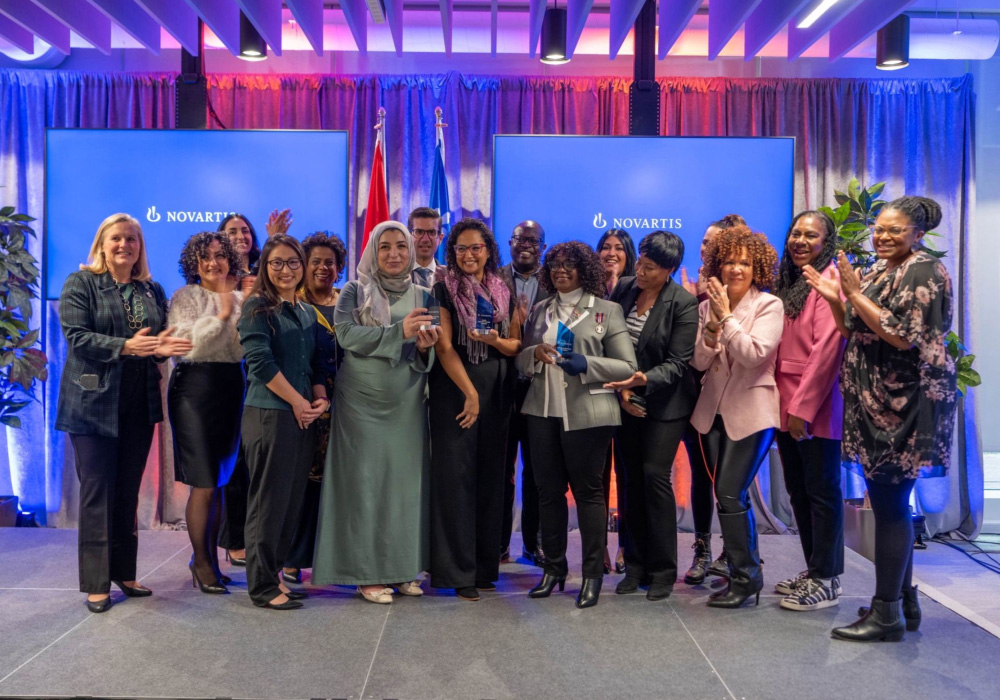
A dynamic ceremony in Montreal celebrated three organizations advancing health equity across Canada, highlighting powerful speeches on community leadership, systemic change, and culturally grounded care.
On a crisp November midday in Montreal, leaders from across Canada’s health, advocacy, and community sectors gathered at the Novartis Canada office for an event rooted in purpose: the 2025 Health Equity Initiative Awards Ceremony. The gathering carried the energy of a community determined to reshape the structures that dictate who receives care, who is heard, and who is included. With the Honourable Marjorie Michel, Federal Minister of Health, in attendance, the morning began with a shared sense of possibility.
Now in its second year, the Novartis Health Equity Initiative remains a key platform for uplifting grassroots and institutional projects that meaningfully address systemic health disparities. This year, three organizations—Moms Against Racism Canada, The Olive Branch of Hope, and Hamilton Health Sciences—were awarded more than $560,000 in funding to expand their work.
Yet what defined the ceremony was not the dollar amount. It was the emotion, clarity, and conviction expressed by the speakers, each of whom named the realities their communities face and the futures they are working to build.
Setting the stage: Novartis highlights the power of listening
The ceremony opened with remarks from Rosa D’Acunti, Country Communications and Patient Advocacy Head at Novartis Canada. Her message underscored why a major pharmaceutical organization would invest so deeply in community-led interventions.
“At Novartis Canada, listening to patients guides the decisions that we make,” she said. “The same attentive approach that helps us understand their needs inspires us to listen to the voices of communities across the country.”

Her emphasis on listening—as an action, not a slogan—framed the rest of the event. According to D’Acunti, the initiative is not simply a funding program but part of a larger commitment to building “a more equitable future for Canadians” through partnerships rooted in trust and shared purpose.
With over 330 applications submitted since the initiative’s launch in 2024, Novartis has now distributed more than $1.2 million to projects that address structural barriers to care. As D’Acunti noted, the goal is to “amplify the impact of organizations that are driving much-needed change.” The recipients’ speeches would later reveal just how deeply this recognition resonates.
Honourable Marjorie Michel: Health equity begins with community strength
When The Honourable Marjorie Michel, Federal Minister of Health, took the podium, her speech connected federal policy, community realities, and the human impact of health inequity with clarity and candour.
She began by grounding the room in a truth widely felt in Black, Indigenous, and racialized communities: health is shaped not only by biology or medical access, but by the social determinants that dictate income stability, housing, safety, and cultural well-being.
“Even with the progress our society has made, discrimination, racism, and historical and present-day trauma can have a profound impact on health,” she stated. “That is why all levels of government and organizations must collaborate to build a more equitable society—particularly in access to healthcare, mental health supports, and essential services.”
She outlined significant commitments from Canada’s 2025 federal budget, including:
- A $50-billion fund to build strong communities, with
$5 billion dedicated specifically to health infrastructure. - The modernization and expansion of hospitals built decades ago but now serving far larger populations.
- A comprehensive assessment of health infrastructure and healthcare needs in northern and remote areas, particularly for Indigenous communities.
- The expansion of the Canadian Dental Care Plan to adults aged 18–64 makes preventive dental care accessible to millions, especially those in rural or vulnerable communities.
Her speech also delivered a message that resonated in the context of the day's awards:
“When Canadians are healthy, they can take care of their families, contribute to their community, and sustain the strength of our economy. When Canadians empower one another, everyone benefits and Canada prospers.”
She closed with gratitude to this year’s winners for “leading real, on-the-ground projects” and reminded the room that collective action is the engine of national well-being.
Voices of the 2025 Award recipients
If Minister Michel’s speech established the systemic landscape, the voices of this year’s award recipients showed how structural inequities unfold—and are resisted—within real lives and communities.
Each speech carried a distinct emotional register: relief, gratitude, urgency, resolve. But together, they formed a narrative arc about what it means to challenge inequity and build new models of care from the ground up.
Moms Against Racism Canada: Reimagining neurodivergent care through a justice lens
Kerry Cavers, Founder and Project Director of Moms Against Racism Canada, delivered a speech that blended personal story, structural analysis, and a call to collective imagination.
She opened with a moment of vulnerability—a visceral response to learning her organization had been selected.
“It was the cracking open of what happens when hope finally meets validation,” she said. “It was a moment of deep affirmation for our work and for the Black, Indigenous, and racialized communities, caregivers, families, and youth who’ve been overlooked and whose needs have been unmet in systems never built for them.”
Cavers described her organization’s mission: dismantling systemic racism and building equitable futures through education, healing, and advocacy. She also highlighted the pivotal role of Dr. Jilleun Tenning and the team at InFocus Counselling Clinic, the NeuroEquity Project’s clinical partner.
Her personal story was one of profound transformation:
“We went from daily dysregulation to a thriving, proudly neurodivergent family. That personal transformation fuels our shared mission.”
She spoke with conviction about the systemic barriers neurodivergent BIPOC children and families face, including:
- Misdiagnosis or missed diagnosis due to anti-Black racism and bias.
- Behaviour interpreted as defiance rather than neurodivergence.
- Long waitlists and inaccessible systems.
- The absence of culturally informed and trauma-aware care.
“We are here to change that,” she declared.
The Novartis funding will allow Moms Against Racism Canada to:
- Scale a culturally grounded, trauma-informed model of care.
- Expand access to timely diagnosis and affirming mental health services.
- Build tech-enabled tools for under-resourced communities.
- Empower people with lived experience to become leaders in care delivery.
Cavers closed with a vision rooted in justice and humanity:
“We imagine a future where every child, no matter their race, how they think, learn, or feel, is celebrated and honoured as a whole. Where healing is not a privilege, it is a right.”
The Olive Branch of Hope: Advancing equity in breast cancer care for Black women
Leila Nichols Springer, Founder and Executive Director of The Olive Branch of Hope, delivered a reflection full of emotion, history, and unwavering commitment.
“When I learned we had been selected, I felt years of struggle, prayer, and unwavering commitment had finally been seen and honoured,” she said. Her speech carried the weight of nearly 25 years of advocacy for Black women navigating breast cancer.
She described The Olive Branch of Hope as a sanctuary—a place where women receive culturally safe education, support, and empowerment in an environment that honours their lived experiences.
Nichols Springer spoke candidly about the disproportionate risks Black women face:
- Earlier onset of breast cancer—even in their 20s and 30s.
- Higher likelihood of late-stage diagnoses.
- Increased incidence of aggressive subtypes such as triple-negative breast cancer.
- Systemic underrepresentation in research and data.
- Persistent barriers to screening and culturally relevant care.
“Inequity is not just a statistic,” she said. “It affects survival, dignity, and trust.”
The Novartis funding will help the organization:
- Host a series of community-centred breast cancer screening events.
- Expand health education and self-advocacy workshops.
- Reach younger women and those at higher risk.
- Extend programming beyond Ontario into Alberta, Nova Scotia, and Quebec.
She emphasized that the support is “transformative,” not merely financial, and enables system-level change.
Her closing words honoured both survivors and those lost:
“Success is a future where every Black woman has access to early detection, equitable treatment, and a community that holds her with love and dignity. This award brings us one step closer.”
Hamilton Health Sciences: Embedding equity into clinical systems
The third recipient, Hamilton Health Sciences (HHS), was represented by Rochelle Reid, Senior Lead and Strategic Advisor for Equity, Diversity and Inclusion.
Her speech highlighted a theme echoed throughout the event: equity requires structural, practical, and data-informed solutions.
Upon receiving the award, Reid said her team felt “gratitude, excitement, and renewed energy,” particularly in a national moment where many organizations are downsizing EDI work.
“It feels great to be seen and heard,” she noted, “especially when the people most impacted by inequities are often the ones least connected to supports.”
She described the scale of the institution—2.3 million patient visits each year—and the communities disproportionately represented in care:
- Newcomers
- Black, Indigenous, and racialized families
- Patients facing housing insecurity
- People living with disabilities
- Individuals without digital access
Her speech pinpointed gaps that deepen inequity:
- Transportation barriers
- Inability to pay program fees
- Digital exclusion in patient intake processes
- Mistrust rooted in colonial and systemic harm
The Novartis funding will enable HHS to:
- Expand multilingual and accessible equity data collection.
- Embed equity data into Electronic Medical Records to guide clinical decision-making.
- Enhance social prescribing, allowing clinicians to prescribe supports like gym passes, bus and taxi vouchers, or housing resources.
- Connect patients directly to community services that address social determinants of health.
“Equity data collection isn’t the project. What we do with it is the project,” Reid emphasized.
“This funding allows us to act on what patients tell us—now, not later.”
She closed with a powerful vision:
“We imagine a future where every patient is met with care that honours their identity, their culture, and their lived experiences. This award brings us one step closer.”
A collective moment of accountability and hope
The 2025 Novartis Health Equity Initiative Awards Ceremony was more than an awards presentation. It was a reflection of the profound work being done across Canada to close gaps, challenge unequal systems, and rebuild trust in care.
Throughout the morning, one idea echoed across every speech:
Health equity is not theoretical. It is lived, it is urgent, and it requires collaboration across government, communities, researchers, and storytellers.
The voices in the room—Minister Marjorie Michel, the Novartis leadership team, and the three award recipients—brought clarity to a simple truth: when community-led organizations are resourced, entire systems shift.
As the event concluded, attendees left with a shared understanding that health equity is a long-term commitment. But on this November day in Montreal, the path forward felt both grounded and illuminated—fueled by the stories, voices, and visions of those working relentlessly to ensure that every person in Canada receives the care they deserve.