

Holla Jazz marks its 10th anniversary with The Room Upstairs, a world premiere choreographed by Founding Artistic Director Natasha Powell and inspired by John Coltrane's creative process. Running April 29 to May 2, 2026, at Toronto's Winchester Street Theatre, the production fuses Black vernacular jazz dance with a live six-piece ensemble. In this conversation, Powell reflects on a decade of searching, community, and what Coltrane continues to teach her.
There are moments in an artist's life when two significant things arrive at exactly the same time, and the convergence feels less like a coincidence than like something earned. For Natasha Powell, this is one of those moments. The Founding Artistic Director of Holla Jazz is marking her company's tenth anniversary not with a retrospective or a celebration of past work, but with a bold, forward-facing gesture: The world premiere of The Room Upstairs, a full-length work inspired by and set to the music of John Coltrane.
The production runs April 29 to May 2, 2026, at the Winchester Street Theatre, presented in partnership with DanceWorks and Toronto Dance Theatre, and it arrives in a year that carries particular weight. 2026 marks what would have been Coltrane's 100th birthday, making the timing feel, if anything, inevitable.
Powell founded Holla Jazz in 2016 with a clear artistic purpose. She set out to present historical jazz dances in a contemporary aesthetic and to build a space where Black vernacular movement could be seen and understood for what it always has been. A decade in, the work is very much still in progress. That, she says, is exactly the point.
The search that never ends
Ask Powell whether she feels she has achieved what she set out to do, and she will tell you, thoughtfully and without hesitation, that she is still searching. It is a position she holds with pride, not apology. "I think about John Coltrane's music right now," she said during our recent conversation.

"He was always about searching and the yearning for the purity of humanity or the purity of sound." She identifies with that restlessness, not as a sign of something unresolved, but as the engine of serious artistic practice. A decade of award-winning work, commission credits, and institutional recognition has not quieted the question of what else is possible. If anything, it has deepened it.
That searching brought Powell to Coltrane years before The Room Upstairs took shape. In 2017, a friend invited her to a screening of the documentary Chasing Trane at Hot Docs, and the film changed something for her. It was the humanity behind the music that landed hardest: Coltrane's life journey, the obstacles he moved through, his spiritual awakenings, and his decision to reach for something more profound through sound.
"This is a human being striving for something greater," she recalls thinking. The music she already knew. The man, in fuller dimensions, became a sustained source of creative motivation.
What jazz dance looks like on a Canadian stage
Holla Jazz occupies a particular and largely uncrowded space within Canadian dance. Opportunities to see jazz vernacular dance performed on stage, rather than experienced socially at a club or gathering, remain limited. The company aims to reinvigorate jazz dance alongside various forms of Black American vernacular dance, treating them as innovative and important vehicles for expression while showcasing freedom and individual identity through the spirit of jazz. Powell acknowledges that a handful of companies are doing this work nationally, including Decidedly Jazz Danceworks in Calgary, which has been presenting jazz dance for decades. But the field is narrow, and the stakes attached to it are real.
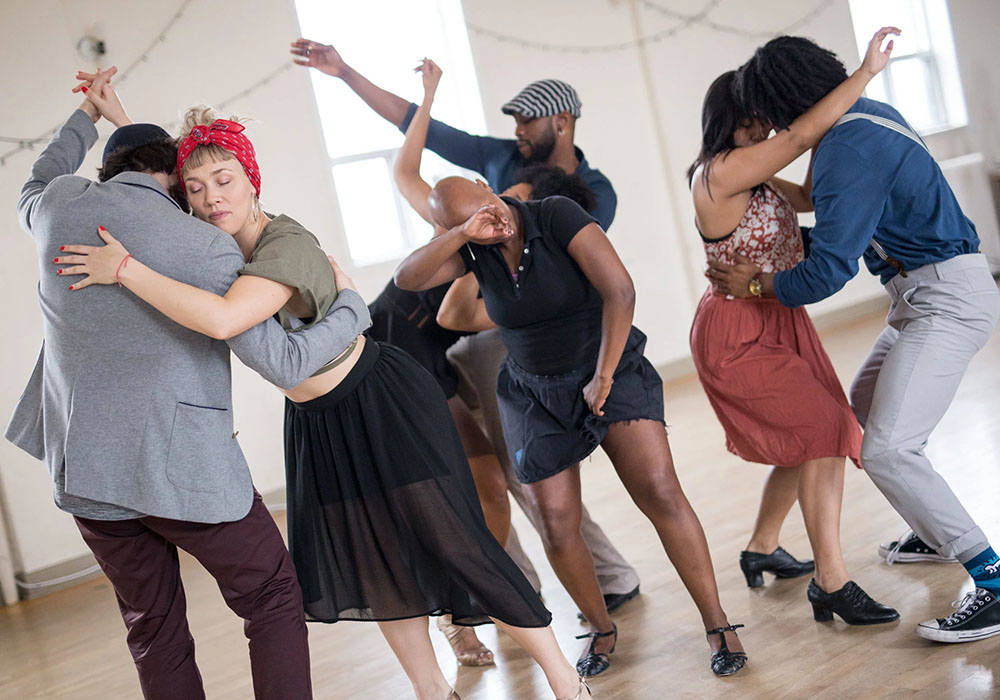
Part of what makes that visibility complicated is the ongoing tension between celebrating a Black art form and losing its cultural roots in the process. Jazz, in both its musical and dance expressions, has a long history of being appreciated aesthetically by expanding audiences while its Black American origins get quietly deprioritized. Powell addresses this directly through the two-stream approach Holla Jazz has built over a decade. Performance and education are not separate offerings — they are structurally linked.
The workshops and classes are where history, cultural context, and movement language are taught together. Participants learn not just the steps but the why behind them. "The first place that we start for folks to really understand the dance is in the workshops," Powell explained. "And then hopefully they see that application through performance." Her choreography for the stage is always rooted in what she describes as the Black American aesthetics of polyrhythms, pulse, and the visible embodiment of rhythm — qualities she consistently returns to as guideposts.
What The Room Upstairs holds
The Room Upstairs is a world that holds space for devotion, camaraderie, and grief, and it centres on an intimate detail from Coltrane's life: the room in his family home where he would retreat to practise and create. That image gave Powell a lens through which to explore something she has returned to across multiple Holla Jazz productions — the relationship between space, environment, and creative thought.
Her earlier work, Floor'd, drew on the cultural world of the juke joint; this new piece draws on a private room in a domestic space where genius sharpened itself in solitude and communion. What these locations share, she says, is their capacity to evoke imagination, introspection, and questioning. She is less interested in biographical portraiture than in what a particular space makes possible — what it allows a person to feel, risk, and discover.
The production features a six-piece live ensemble performing some of Coltrane's most celebrated compositions, including "Giant Steps," "Naima," "Aisha," "Lazy Bird," "Syeeda's Song Flute," and "My Favourite Things." Musicians Tom Richards on trombone, Thompson Egbo-Egbo on piano, Eric West on drums, Scott Hunter on bass, Colleen Allen on saxophone, and Rebecca Hennessey on trumpet bring the score to life. Working with live musicians changed the production in ways Powell could not fully anticipate when she began choreographing against recordings. The recordings gave her the shapes and textures she needed to build initial movement language. Then the live ensemble arrived in rehearsal.
What followed was a shift in kind, not just degree. Breath entered the room. The musicians became responsive presences rather than fixed tracks, watching the dancers, responding to the action on the floor. The dancers, in turn, became physical embodiments of musical texture. "There's the element of breath and witnessing and being responsive to each other," Powell said. "It's been really nice to hone in on that interplay." That back-and-forth remains one of the most alive elements of the production: two art forms in conversation, neither subordinate to the other.
The dancers who built this with her
The four Toronto-based dancers at the centre of The Room Upstairs are Raoul Wilke, Caroline "Lady C" Fraser, Hollywood Jade, and Miha Matevzic. Powell has worked with each of them since Holla Jazz's earliest days. They came to the company with strong backgrounds in street dance and other Black vernacular forms, and she was interested from the beginning in watching how dancers already fluent in those vocabularies would adapt to jazz vernacular specifically. The answer, over a decade of collaboration, has been that they do far more than adapt. They contribute creatively and critically, offering ideas in rehearsal, questioning choices, and bringing thoughtful insight to the process this work requires.
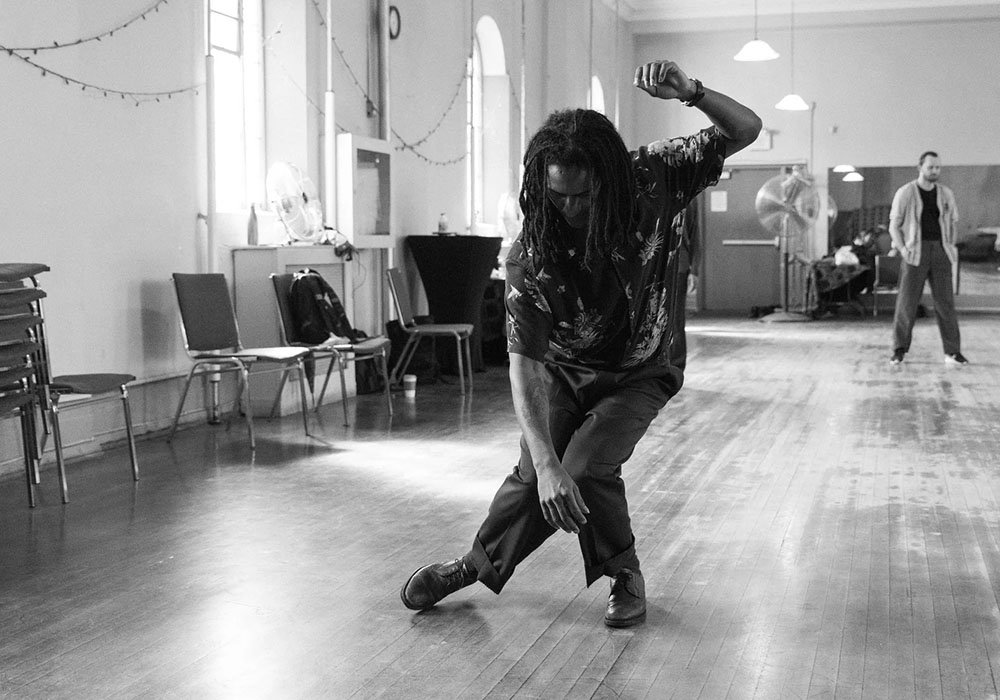
Their involvement in The Room Upstairs reflects something Powell deeply values. This kind of work is made, not handed down."They're all creators and choreographers in their own rights and in their own projects as well," she noted. The room they inhabit during rehearsal is collaborative, and that dynamic carries into what an audience ultimately sees on stage.
What ten years, a Dora, and a Metcalf Prize make possible
Holla Jazz arrives at this anniversary with a track record that speaks for itself. Floor'd, the company's second full-length production, earned a Dora Mavor Moore Award for Outstanding Ensemble Performance and was praised for its "choreographic brilliance — exciting, yet cool, powerful and smooth." The company's production, Young Gifted and Jazz, earned a Dora for Outstanding Production.
Powell has choreographed work commissioned by Fall for Dance North, collaborated with the National Ballet of Canada, and worked on theatre productions for Canadian Stage. In 2023, she received the Johanna Metcalf Prize in the Performing Arts, which recognizes Ontario artists working across disciplines.
None of that came easily or independently. The Room Upstairs exists partly because of the institutional partnerships that make ambitious work possible in Toronto's dance sector under current conditions. Shared resources, access to presentation infrastructure, and the combined reach of DanceWorks and Toronto Dance Theatre enabled this production.
Powell is frank about the economics. In the arts right now, particularly in Toronto's dance scene, there is no other realistic path. The question is how to build something meaningful within those conditions, and how to bring organizations together in service of the work and the community it reaches.
Where Holla Jazz goes from here
Looking ahead to the next decade, Powell is thinking in terms of expansion — not just of ambition but of form. She wants to explore different shapes and contexts for presenting jazz dance, beyond conventional stage productions. She is also moving toward formalizing the company's structure, pursuing incorporation and not-for-profit status to better support Holla Jazz's educational programming.
The vision is a sustainable, cross-Canada jazz dance community, rooted in the same commitment to cultural context and rigorous practice that has defined the company's first ten years.
The room you walk out of
Two of the most compelling things about The Room Upstairs are also, in some ways, the simplest to describe. First: it offers something genuinely rare on the Canadian stage, a sustained encounter with Black vernacular jazz dance performed to live music at the highest level of craft. For anyone who came because of Coltrane, the dancing will be a revelation. For anyone who came for the dancing, the music will find new meaning.
Second, and perhaps more lasting: the work asks its audience to sit with what it means to strive — not toward a finished thing, but toward something more honest and more human. Coltrane spent his life reaching for that. Natasha Powell, a decade into her own search, is still reaching too. The room upstairs was always where the real work happened.
The Room Upstairs runs April 29 to May 2, 2026, at the Winchester Street Theatre, 80 Winchester Street, Toronto. All performances begin at 7:30 p.m. Tickets start from $15 and are available at hollajazz.com and tdt.org.