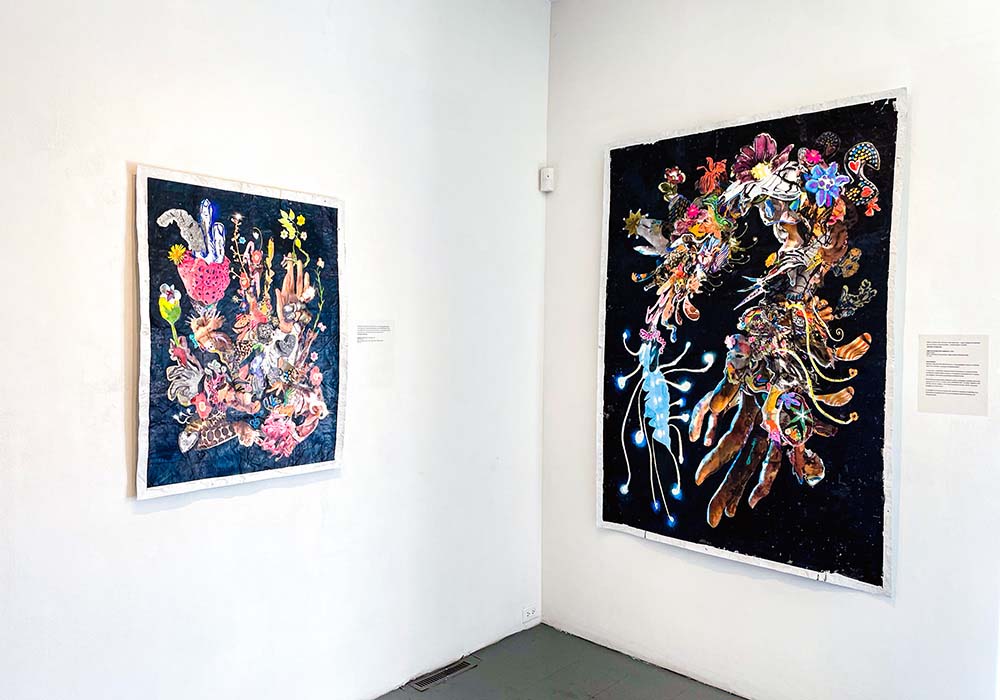
A chance walk from the Junction to Parkdale led to Kikospace on Dundas Street West, where Armova Curatorial's newest show reimagines bell hooks' classic All About Love. Running through June 28, "When Angels Speak of Love" gathers eight Black diaspora artists exploring love through painting, photography, sculpture and textile, each in a different register. The result treats hooks' philosophy as a discipline put into practice.
A recent long walk from the Junction neighbourhood toward Parkdale passed a storefront gallery on Dundas Street West, with an appointment to keep and barely a minute to spare. The artwork visible through the window was reason enough to step inside anyway. What turned out to be there was Kikospace, a gallery space that has quietly hosted experimental art for years and is currently home to Armova Curatorial's newest group exhibition, "When Angels Speak of Love."
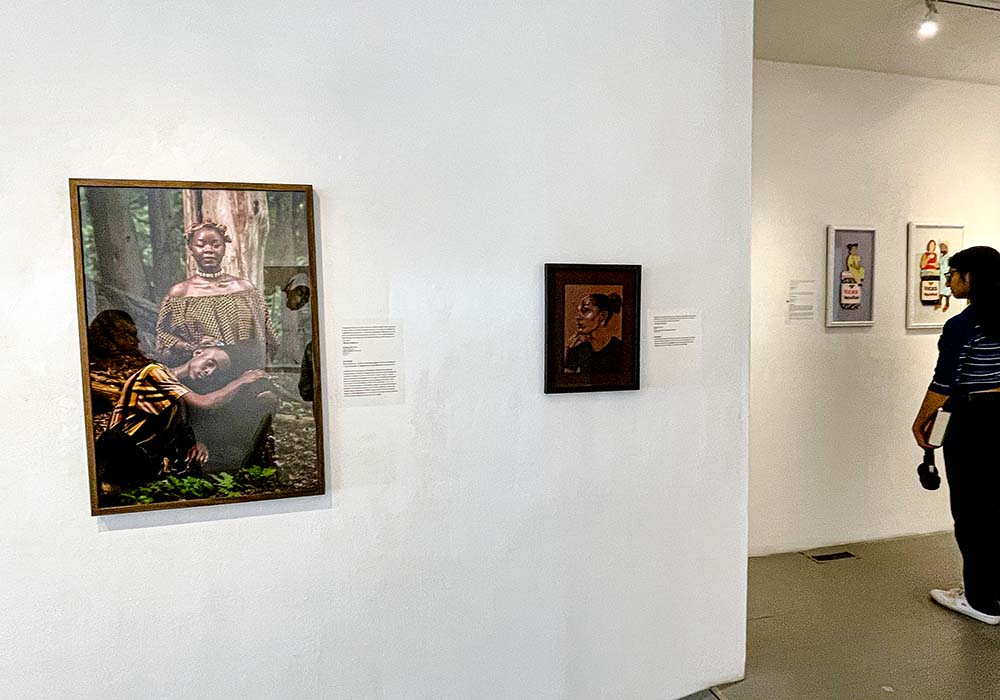
The show takes its title from the final chapter of bell hooks' 2000 book All About Love: New Visions, and it asks eight artists connected to the Black diaspora to translate hooks' ideas about love, care and justice into paint, photography, textile and sculpture. The result treats love as a subject of serious inquiry rather than a backdrop for sentiment, closer in spirit to a philosophy seminar than a Valentine's Day group show.
A philosophy built for paint and fabric
bell hooks spent much of her career challenging the idea that love is something that simply happens to people. In All About Love, she argued that genuine love works more like a practice than a feeling, built from care, commitment, knowledge, responsibility, respect and trust rather than romantic chance. She traced a lot of our collective confusion about love back to how families model it, or fail to, and pointed out how readily a society can avoid telling the truth about its own loneliness.
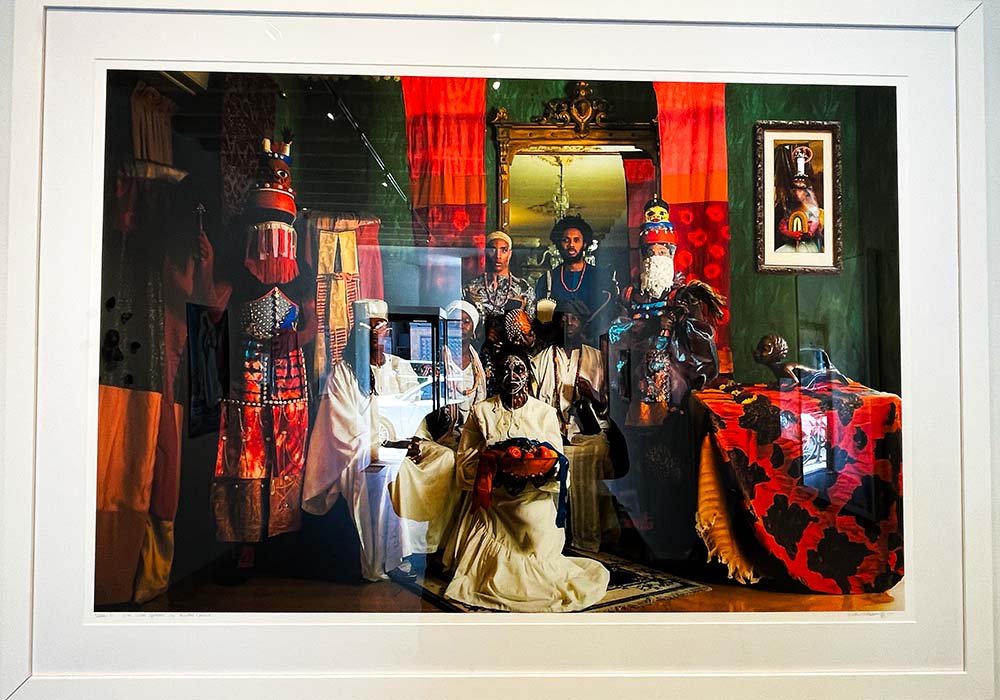
Armova Curatorial, the Toronto-based curatorial practice led by Byron Armstrong and Ilene Sova, built this exhibition directly from that framework. Their previous project, "Too Much Fashion," established the duo's interest in pairing big cultural ideas with contemporary visual art, and When Angels Speak of Love extends that approach into something more intimate. Armstrong and Sova describe their curatorial practice as a form of storytelling that values community knowledge and lived experience over academic distance, and that sensibility shows in how the show is organized. Rather than illustrating hooks' arguments literally, the eight participating artists respond to themes she raised, including self-love, grief, domesticity, friendship and collective liberation, each through their own visual language.
Eight artists, eight answers to the same question
What makes the exhibition work as a cohesive show rather than a loose grouping is the range of disciplines on display. Painting sits next to photography, sculpture sits next to textile, and each artist arrives at hooks' central question from a different angle, shaped by their own background and training. A quick look at where these artists come from and what they work in gives a sense of the breadth involved.
| Artist | Discipline | Background |
|---|---|---|
| Natia Lemay | Interdisciplinary, autoethnographic practice | Born in Toronto, raised in Winnipeg; MFA from Yale School of Art |
| Veronica Dorsett | Mixed media, visual art | Born in Freeport, Bahamas; based in Toronto |
| Eddion Alexander Whyms | Painting, mixed media | Bahamian painter exhibiting internationally |
| Elyse Skye Ricketts | Oil painting | Based in Vaughan, Ontario |
| Suzan (Destinie) Adélakun | Sculpture, photography, textile, film | Based between New York and Toronto |
| Ojo Agi | Figurative drawing | Nigerian-Canadian; based in Toronto |
| Anthony Gebrehiwot (Tony Tones) | Photography | Based in Scarborough, Toronto |
| Steven Schmid | Painting, collage, assemblage | Bahamian interdisciplinary artist based in Toronto |
Natia Lemay's autoethnographic approach uses personal history to examine how mind, body and space intersect, an angle that fits naturally with hooks' insistence that love starts with how we understand ourselves. Lemay has built an impressive exhibition record, including a National Trust Prize win at Expo Chicago and works held by the Art Gallery of Ontario and the High Museum in Atlanta, and her presence here grounds the show in a serious contemporary art conversation.
Veronica Dorsett, who trained at Emily Carr University after starting her studies in the Bahamas, brings a critical lens to Black hair politics and childhood memory, themes that connect to hooks' writing on how love (or its absence) gets transmitted across generations.
Steven Schmid draws on hip hop production techniques as a visual method, using collage and assemblage to question patriarchal expectations of Bahamian masculinity, while Eddion Whyms works through acrylic and charcoal to explore vulnerability and inherited belief within a similarly male-coded frame.
Ojo Agi's minimalist figurative drawings of Black women, rendered in delicate line work on brown paper, build a body of work centred on emotional softness, framed as a direct response to hooks' belief that affection itself can resist oppression.
Anthony Gebrehiwot, the Scarborough-based artist and former resident photographer at R.I.S.E. Edutainment, draws on years of documenting Toronto's pan-African creative community in his portraits, which sit at the intersection of race, masculinity and raw emotional exposure.
Suzan Adélakun, founder of the Future Griots Collective, works across sculpture, photography, textile and documentary film exploring water-rooted spiritual traditions and the long history of Black communities pushed off the coastlines they once called home.
Elyse Ricketts rounds out the group with tightly cropped, dreamlike oil paintings that explore emotional dependence and the tension between being seen and remaining unknowable.
Planning your visit
Kikospace operates by appointment for most of the year, so the public hours during this exhibition are worth noting if a visit is on the agenda. The opening reception already took place on Thursday, June 11, but the show itself runs for over two weeks afterward, with free public programming planned throughout, including gallery tours and an activation in partnership with MakeRoom Inc. Everything connected to the exhibition is free and open to the public, funded in part by the Toronto Arts Council.
- Location: 2104 Dundas Street West, Toronto, Ontario
- Exhibition dates: Friday, June 12 through Sunday, June 28, 2026
- Gallery hours: Wednesday to Friday, 10 am to 5 pm; Saturday and Sunday, 12 pm to 4 pm
- Admission: Free
- Follow updates: Armova Curatorial (@armovacuratorial) and the hashtag #WhenAngelsSpeakOfLove
The building also shares its address with Narwhal, a contemporary gallery that has operated out of the same space for years, putting two distinct curatorial sensibilities under one roof at the corner of Dundas Street West and Howard Park Avenue, in a stretch of Roncesvalles that has quietly built a reputation for artist-run spaces.
Beyond the gallery walls
The exhibition's lasting effect comes from watching eight artists answer the same difficult question in eight distinct visual languages, rather than from any single image or statement. bell hooks wrote about love at a moment when she believed her own society had largely abandoned the effort to define it honestly. "When Angels Speak of Love" takes up that argument without turning it into an academic exercise, proposing instead that love operates as discipline and practice well before it operates as feeling, and that this discipline extends as readily to community and justice as it does to romance.
That argument is what separates this exhibition from a more conventional group show built around a loose theme. Grief, self-love and collective liberation share the same room here without contradiction, and the work makes a case for art as one of the more rigorous ways to think through what care actually requires.
The show runs until June 28, on a quiet stretch of Dundas Street West, easy to miss and, on this occasion, worth the detour.