Toronto has no shortage of photographers, but a distinct generation of Black image-makers is doing something different. They're building visual worlds rooted in community, diaspora, and cultural pride. From intimate Caribbean family portraits to bold fashion-forward imagery and youth mentorship programs, these artists are reshaping what the city looks like on screen and in print. Their work is urgent, personal, and impossible to ignore.
Walk through almost any Toronto neighbourhood, and you'll find stories worth telling. The aunty selling plantain in Scarborough. The kids from Regent Park with cameras around their necks, learning to see their own block differently. The Jamaican-Canadian woman is laying out her father's old 35mm slides next to her own portraits, searching for threads of connection across decades and coastlines. These stories exist.
The question is who gets to tell them, and how.
A growing cohort of Black photographers in Toronto has made that question the engine of their entire practice. They aren't waiting for mainstream media to decide their communities are worth photographing. They're building the archive themselves. Their work spans portraiture, fashion, documentary, and multimedia art. What binds it is a shared insistence on telling Black stories with depth, beauty, and complete creative ownership.
This is a look at five of those artists, what drives them, and why their work matters right now.
Jorian Charlton: Intimacy as an act of representation
Jorian Charlton is a Toronto-born portrait photographer whose practice is rooted in a passion for capturing the essence of Black culture. Her work explores themes of family, intimacy, community, and love, using careful attention to lighting, atmosphere, fashion, and pose to construct compositions that reveal profound stories and raw emotion.
Charlton's work focuses on Jamaican-Canadian culture, contemporary modes of Black representation, and concepts of beauty. She favours natural light and candid shots, and she and her father both focus on women and children. There is, she says, a tender and warm quality to the pictures they take.
Her project, Out of Many, pairs her own contemporary portraits alongside her father's vintage 35mm slides from Jamaica, New York, and Toronto in the late 1970s and 80s. The work sparked many questions about ancestry and immigration. "I believe that this collection will forever have to speak for itself in some ways," she says, "and part of me is okay with that."
The impact of Charlton's work extends well beyond her studio. She has had solo exhibitions at Gallery TPW, the Art Gallery of Ontario, Cooper Cole Gallery in Toronto, and the Art Gallery of Mississauga. Her work is included in the travelling exhibition The New Black Vanguard: Photography between Art and Fashion and As We Rise: Photography from the Black Atlantic, Selections from the Wedge Collection.
For Charlton, Toronto is a city that doesn't try to impress you, and that's exactly what makes it special. "Toronto isn't flashy about what makes it unique," she says. "It kind of unfolds over time." Inspiration often comes on foot, walking through neighbourhoods to scout locations, or simply to reset.
- Website: joriancharlton.com
- Instagram: @jjjorian
- Gallery representation: Cooper Cole Gallery, Toronto
William Ukoh: Building a world between Lagos and Toronto
In William Ukoh's photographs, a face's scattered freckles rhyme neatly with stars. The tallest woman you've ever seen looms above a city. Couples pose against sheets of mottled sky, skin luminous as trapped sunshine. As the images accumulate, a setting crystallizes: a sun-drenched arcadia of leisure and Black beauty that Ukoh calls the "Willyverse," an imagined midway point between Nigeria and Canada.
The style began to take shape during a 2014 trip back to Nigeria. "I was very inspired by all the colours I saw," Ukoh explains. "When I came back to Toronto, I was met with this grey landscape. That was a very stark difference. I was trying to figure out how to merge those two worlds or at least bring back that feeling."
The result is a visual language that feels entirely his own. His work has attracted global brands such as Adidas, Canada Goose, Holt Renfrew, and Puma, as well as publications such as Vogue and GQ. A natural storyteller and cultural historian, Ukoh challenges viewers to reconsider familiar ideas through a contemporary cinematic lens.
He has photographed artists and actors for GQ and beauty stories for Vogue Portugal. He has collaborated with fashion designers and exhibited in galleries across New York, Lagos, Toronto, and Amsterdam, all the while refusing to draw a distinction between his fine art and commercial work, preferring to see it all as moving parts of one self-contained universe.
In early 2026, Ukoh was signed to Fela, a Toronto and LA-based production company, marking another chapter in a career defined by refusing to be categorized. He graduated from Toronto Metropolitan University's film school (previously Ryerson) and has since expanded into photography, film, installation, and design.
- Website: willyverse.com
- Instagram: @willyverse
Roya DelSol: Photography as liberation technology
Roya DelSol approaches the camera as both a creative tool and a political act. She creates photographic, video, and immersive XR work, capturing Black femme intimacies, strength, and joy in hopes of visualizing new, liberated worlds. She sees technology, magic, and ancestral knowledge as not disparate but interconnected frameworks, drawing on the subversive qualities of magical realism to imagine Black futures.
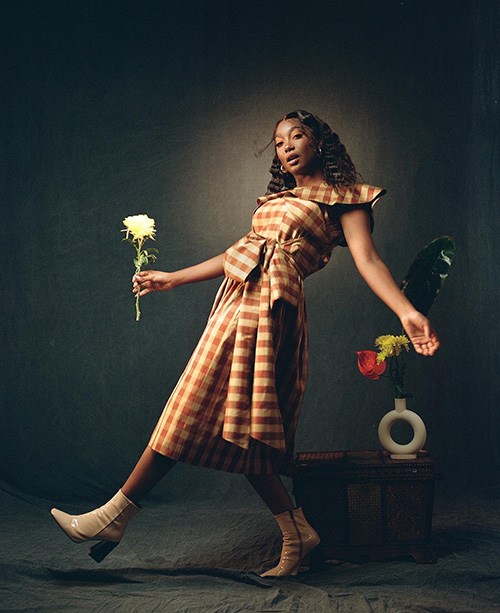
A quick scroll through her Instagram reveals an artist committed to reflecting a real vibrancy back onto the people she captures. In each portrait, her subjects appear illuminated and powerful, commanding the viewer to stop and take notice. That effect is entirely intentional. DelSol has spoken openly about centring her subjects' emotional experiences above all else.
Her client list tells the story of an artist working fluidly across commercial and community spaces. Her imagery has been used by Spotify, Adidas, YouTube, Amazon Music, Aritzia, FLARE, the Art Gallery of Ontario, NXNE, and the Globe and Mail. She has also curated exhibitions at the Doris McCarthy Gallery at the University of Toronto Scarborough, Trinity Square Video, and the Margin of Eras Gallery in Parkdale.
Raised in Ajax, Ontario, DelSol has spent years in Toronto's art scene, working as an arts advocate and actively creating environments where artists can access resources and support. "There are so many talented people out there who don't have the material resources to get things done," she says. "It's hard to dream when you are worried about making it day to day."
That commitment to community infrastructure is woven into every dimension of her practice. For DelSol, photography is an act of care.
- Website: royadelsol.com
- Instagram: @royadelsol
Yasin Osman: Turning the lens on community to save it
As a housing project came down, a photographer was born. Yasin Osman grew up in Regent Park, one of Toronto's most underserved neighbourhoods. When the city's revitalization plan began demolishing buildings around him, the then-13-year-old picked up his mother's cellphone and started documenting the changes. That impulse never left him.
Today, Osman is one of Toronto's most recognizable documentary photographers, with clients including Nike, Red Bull, the Toronto Raptors, VICE, and UNICEF Canada. He is also a regular contributor to The New Yorker, where his cartoons appear alongside his photographic sensibility for human detail and unexpected intimacy.
His most important initiative remains Shoot for Peace, a photography mentorship program he founded in 2015. The program was created to offer an alternative for youth in Toronto affected by violence, and to provide them with skills and opportunities in photography. First launched in Regent Park, it has since grown to other communities.
The program was sponsored by Canon and has been widely featured in outlets including American Photo Magazine and CNN. Its participants have gone on to shoot community events, festivals, and exhibitions across the city.
For Osman, the most important thing is the opportunity for people to see a different, more caring version of the communities' mainstream media typically flattens or ignores. His own photographs do exactly that: they find warmth in difficult places, and document what resilience actually looks like from the inside.
- Website: yescene.com
- Instagram: @yescene
Brianna Roye: Film, community, and the queer Caribbean archive
Brianna Roye grew up in Toronto's Black Creek neighbourhood and started shooting in her last year of high school before graduating from Humber College's Creative Photography program. She has spent years documenting the ephemeral magic of Toronto's constantly shifting arts scene, along with the artists and producers who bring those moments to life.
Her most significant ongoing work is the portrait series Out of Many, One People, a long-form project documenting 2SLGBTQI+ people of Caribbean descent. The Jamaican phrase "Out of Many, One People" was originally conceived to highlight the island's racial diversity, but Roye and people like her were never included in that sentiment. "This series pushes back against that homophobia and serves as archival documentation for what it means to be queer and Caribbean," she says.
Roye uses intention as a guiding principle, striving toward organicness in her imagery. "I try to take photos of people as they are," she says. "I like to capture people's beauty and essence in as honest a way as I can." She has shot for Adidas, with work featured in Maclean's and FLARE, and has photographed festivals including ManifesTO and Afropunk.
Roye shoots primarily on film, a deliberate choice that slows the process down and forces a different quality of attention. The results are warm, textured portraits that feel pulled from another era while speaking directly to the present.
- Website: briannaroye.com
- Instagram: @briannablank
Where to find their work in Toronto
The gallery and festival landscape in Toronto provides meaningful spaces to encounter this work in person. The Scotiabank CONTACT Photography Festival, held each May, regularly features Black photographers in both indoor exhibitions and large-scale public installations across the city. Cooper Cole Gallery on Dupont Street represents Jorian Charlton and consistently presents work by contemporary artists at the forefront of Canadian photography. Gallery TPW on St. Helen's Avenue, described by Charlton herself as community-driven and artist-run, offers a more intimate space for dialogue and experimentation. The Nia Centre for the Arts in Scarborough, Canada's first professional Black arts centre, is another essential institution for encountering emerging Black visual artists year-round.
Keep an eye on the Scotiabank CONTACT Photography Festival each spring, the AGO's ongoing programming, and the Nia Centre's events calendar for the next opportunity to see this work up close.
A visual culture still being written
The photographers working in Toronto today are not simply documenting a community. They are actively building one, frame by frame, series by series, mentorship program by mentorship program. As Jorian Charlton puts it, "I hope people will be inspired and feel seen. I hope there are more opportunities like this for BIPOC artists. I will keep pushing for new opportunities that help others feel included and represented in their local communities."
That spirit animates this entire generation. Whether through the magical colour worlds of William Ukoh, the liberatory portraiture of Roya DelSol, Yasin Osman's community-rooted documentary work, or Brianna Roye's tender film portraits of queer Caribbean lives, these photographers are insisting on a Toronto that sees itself fully. The city's visual story is still being written, and these are some of the people writing it.